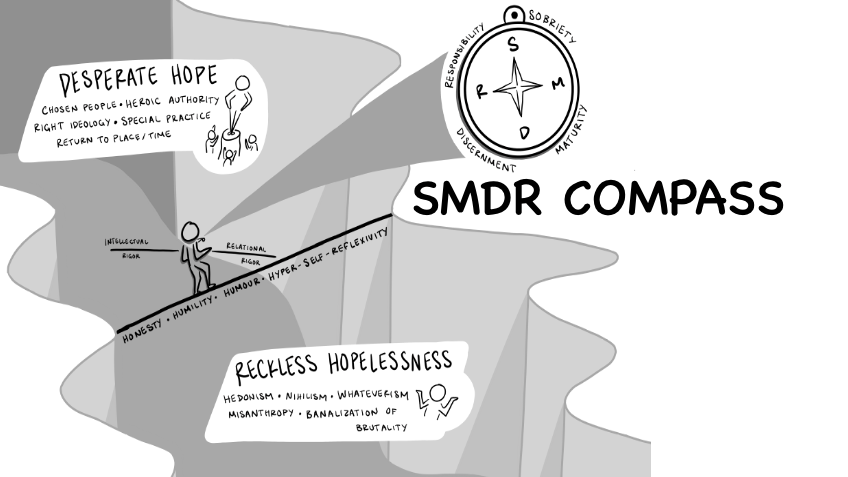
The SMDR compass is both a collaborative regenerative inquiry and a set of orienting directions that invite people to deepen their capacities to move with deeper emotional serenity/sobriety, relational maturity, intellectual discernment, and intergenerational responsibility. We share our current notes on the SMDR compass below.
S – emotional serenity/sobriety (choosing rehab over assholism and/or fragility):
1) Disinvestment in harmful colonial impulses conditioned and rewarded by society, such as desires for absolute moral and epistemic authority, unaccountable and unlimited autonomy, and the universal arbitration of justice, lawfulness and common sense;
2) Capacity to work through complicity, discomfort, volatility, uncertainty, complexity, ambiguity, paradoxes, tensions, conflicts, and contradictions without responses being driven by emotional demands for comfort, certainty, validation, and affirmation of innocence and virtue; ability to hold space for sadness and pain (individual and collective) without drowning in it;
3) Greater emotional capacity and resilience to confront, acknowledge, and process the difficult and painful aspects of reality without feeling overwhelmed, immobilized or demanding quick fixes to be rescued from discomfort – having the stomach to face external and internal realities without throwing up, throwing a tantrum or throwing in the towel;
4) Cultivation of freedom from compulsive judgment/comparing of self and others (including/especially when recognizing one’s own moments of insobriety), capacity to course-correct and “get to zero” when one is leaning towards “plus one” (desperate hope; saviorism; “My ideas/actions matter most”) or “minus one” (reckless hopelessness; disengagement; “my ideas/actions don’t matter”) in regard to acting with responsibility;
5) Neurophysiology: Capacity to intentionally respond from ventral vagal PNS – wider bandwidth, calm, self-, co-, meta-regulation, rather than reacting from dorsal vagal (PNS: freeze, deny, dissociate) or hyper-aroused SNS (fight, flight, fix).
M – relational maturity (choosing the challenges of eldering over the promised rewards of “youngering”/self-infantilization):
1) Interrupting the colonial conditioning of transactional, utility-maximizing relationship building grounded on certainty, predictability, imposed coherence, control and learning to weave relationships grounded in trust, respect, reciprocity, consent, and accountability;
2) Committing to “eldering”, learning to be compassionate, patient, generous, to set healthy boundaries, to discern when to intervene and when to step back or aside, learning to fall, to fail, to make mistakes, to forgive and to apologise with grace and humility and choosing to do what is needed rather than what one wants to do or makes one “look and feel good”, or what is convenient;
3) Finding grounding beyond the ego and human constructs of identity and plugging in to the umbilical cord that allows the earth to de-activate ego-logical desires and manifest its vision and wisdom through human bodies;
4) Cultivating a lifelong practice of surrender; closing the “eyes” of the analytical, comparison-based, past-and-future-oriented mind and enhancing/awakening exiled capacities; opening to possibility that all entities with which one is entangled through non-judgmental embodied awareness are always available to support one’s balance, instead of seeming to pull one off balance when one is trying to use them to satisfy ego-logical desires and “get something out of” life and fellow entities.
5) Neurophysiology: Serotonin-based “entanglement” rather than oxytocin driven (maternalistic or paternalistic) attachments.
D – intellectual discernment (moving from certainty-driven/solid to inquiry-driven/fluid reasoning):
1) Disinvestment in universalist, Cartesian, allochronic, dialectical, anthropocentric, totalizing, teleological, reductionist reasoning and activating the capacity to to exercise diffractive, diachronic, abductive and analectic reasoning, and polysemic awareness;
2) Capacity to navigate multiple complex moving layers of reality and assess possible opportunities for responsible intervention and experimentation, rather than flattening these layers and imposing coherence in the search for comfort, consensus or definitive solutions;
3) Depth, insight, hindsight, foresight, and trans-systemic thinking and resonance, capacity to differentiate between different onto-epistemologies and different layers and depths of complexity, to trace location, movement and historicity of ideas, to understand nuance, and to self-reflexively track the origins and impacts of one’s assumptions;
4) Recognizing when and why one’s own beliefs, perspectives, desires to be “right” are becoming more important than manifesting love and compassion towards other humans and the more-than-human world (especially in conflicts / disagreements), and the willingness to surrender and compost in these moments.
5) Neurophysiology: Acetylcholine-grounded inquiry as opposed to dopamine-driven mastery as modes for problem-framing, problem-solving and coordination and accountability strategies.
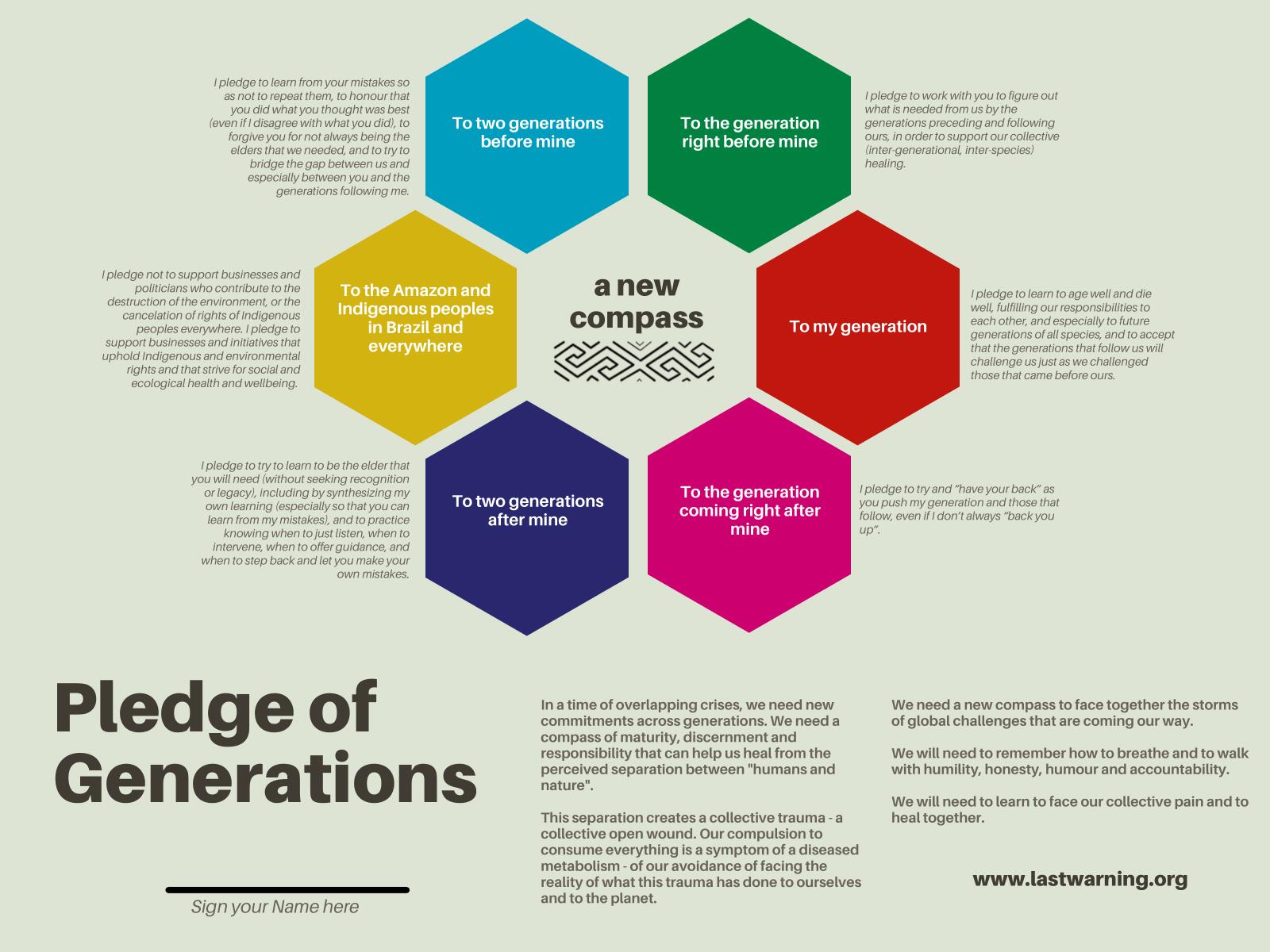
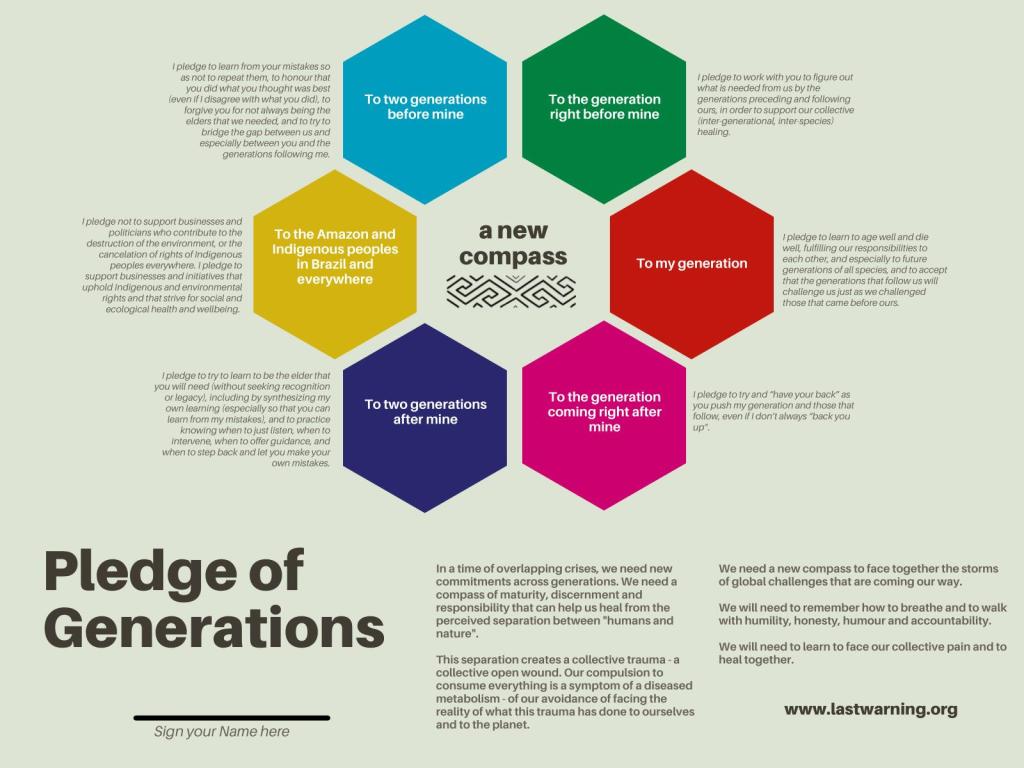
R – intergenerational and interspecies responsibility (“The buck stops here” pledge of generations)
1) Disinvestment in the social contract based on incremental progress and prosperity (debt of the young to the old) and in the hope in the continuity of harmful systems, recognizing implication of one’s generation in harm towards the planet and the future (debt of the old to the young) – investing in hope in the interruption of continuity of harm reproduction;
2) Committing to processing the mistakes of previous generations and integrating its lessons, so that only new mistakes can be made in the future and committing to working across generations so that these mistakes do not continue to get repeated; repairing relations and offering reparations to those who have been harmed
3) The capacity to prioritize the well-being of current and future generations of all species by exercising responsibility beyond self-interest and temporal existence so that we can interrupt destructive inherited patterns and ensure “the buck stops here”;
4) Cultivating a moment-to-moment awareness of inseparability from past and future generations, dissolving any residual desires for legacy, any subtle attempts to deny responsibility, and any illusions of time-based separations
5) Neurophysiology: Change driven by embodied and visceral epigenetic rewiring as opposed to change driven by conceptual, intellectual and transactional choices based on self-interests.
A note on word choice
The words sobriety and maturity in the SMDR compass were chosen with care and intention, fully aware that they might provoke dissonance. We recognize that for some, these terms carry the weight of colonial imposition and are perceived as too saturated to reclaim. This critique is valid and was taken into account.
However, we approach language through the lens of worlding the world, rather than wording the world. The language philosophy of wording the world seeks to fix reality in form—finding language that is “pure,” precise, and descriptive, as if the right words could capture the essence of things once and for all. This is the same impulse that fuels modernity’s obsession with control, certainty, and the illusion of permanence.
In contrast, the language philosophy of worlding the world uses language to move things, to bring attention to dynamics, and to invite new relationships with the words themselves. It’s not about purity or fixing meanings in place, but about creating movement. Words like sobriety and maturity were chosen not because they are perfect or unproblematic, but because they provoke friction—helping surface modernity’s imprints, particularly with people in low-intensity struggle in Western contexts.
In Indigenous and high-intensity struggle contexts, different words are often more resonant—terms like stability, steadiness, or Elderhood. But in other settings, sobriety and maturity create the dissonance needed to open conversations about our libidinal attachments to imprited harmful desires and complicity with harmful systems.
We invite those who feel discomfort with these terms to sit with the tension and ask: What does this word move in me? Rather than seeking language that fixes and resolves, can we engage words as tools to create shifts and hold complexity? This is the work of dancing with language, rather than controlling it that informs our pedagogy. Movement often requires dissonance, friction, and the willingness to let go of purity in favor of transformation.
 Gesturing Towards Decolonial Futures