Difference that makes no difference

10 Ds of disillusionment (with “inclusion”)


Usual starting point (common expectations):

“You are included to justify business as usual”

You come through the back door.

1. Deficit

2. Duty

3. Display


Tipping point (broken expectations):

“You are reminded of your place”

You were allowed in so that you could serve. you cannot simply refuse to meet our reasonable expectations.

4. Debt

5. Distrust

6. Disdain


Degenerative state (justification for replacement):

“You have exposed a problem and become the problem”

…… and we won’t let you get away with it!

7. Discipline

8. Delegitimation

9. Dismissal

10. Denial


Mapping Indigenous Engagements

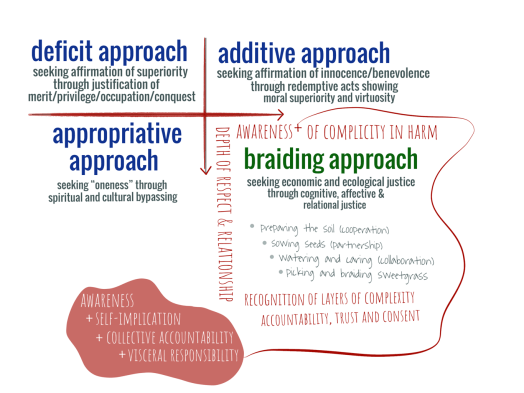
The social cartographies below (that are still work in progress) show two iterations of our attempts to map problematic (i.e. extractive and instrumentalizing) aspects of engagements with Indigenous knowledges and ways of knowing and being, and to articulate, in the “Towards Braiding” possibility, the commitments and dispositions that would be necessary to create the conditions for generative and ethical collaborations between Indigenous and non-Indigenous sensibilities.

The first iteration of the social cartography maps engagement approaches against two dimensions of learning: learning about one’s complicity in systemic, historical and ongoing violence; and learning how to appreciate, respect and relate ethically to Indigenous ways of knowing and being.

Social Cartography 1

In the second iteration we wanted to show that both awareness and appreciation were not enough to create the conditions for the interruption of harmful patterns of engagement. In other words, neither awareness nor appreciation are expressions of “accountability”, which is an aspect of learning that requires both self-implication and a form of visceral responsibility towards not only harm reduction, but also harm interruption. Accountability relates to a form of unconditional solidarity for the “long haul” that can hold space for complexities, paradoxes, tensions, frustrations, failures, mistakes, pain and conflict. This form of solidarity requires both humility and self-reflexivity: a de-centering of the self beyond the virtue-signalling tropes of “feeling good, looking good, doing good and moving forward” and beyond the romanticizations and idealizations often projected onto Indigenous peoples.

Screen Shot 2019-12-17 at 12.19.27

Download a PDF of the two iterations here (PDF).

In the book “Towards Braiding” we define braiding (p. 21-22) as:

“… a practice yet-to-come located in a space in-between and at the edges of Indigenous and non-Indigenous ways of knowing and being, aiming to calibrate each sensibility towards a generative orientation and inter-weave their strands to create something new and contextually relevant, while not erasing differences, historical and systemic violences, uncertainty, conflict, paradoxes and contradictions.

Braiding is not a form of synthesis in which two approaches are combined in order to create a new, third possibility to replace them both. Braiding is also not the result of selective, “salad bar”-style engagements with both sides, taking the “best” or most convenient elements of each and combining them; nor is it the result of an antagonism in which one side emerges triumphant over the other. Instead, braiding is premised on respecting the continued internal integrity of both orientations, even as neither side is static or homogenous, and even as both sides might be transformed in the process of braiding. Braiding opens up different possibilities for engagement without guarantees about what might emerge from those engagements. Braiding is not an endpoint, but rather an ongoing and emergent process. It is not possible to determine what braiding will look like before it occurs. In fact, we propose three “steps towards braiding” that need to happen before any braiding is even possible:

1. a deep understanding of historical and systemic harms and their snowball effects needs to become “common sense,” and not something to be avoided, dismissed, or
minimized out of a fear of hopelessness, guilt or shame;

2. a language that makes visible the generative and non-generative manifestations of both Indigenous and non-Indigenous sensibilities needs to be developed, without becoming rigid, prescriptive or accusatory;

3. a set of principled commitments towards the “long-haul” of this process needs to be in place, including a commitment to continue the work even/especially when things become difficult and uncomfortable.”

The two iterations of this social cartography aims to identify what steps 1 and 3 could entail.


The Haruko Accord

Who is Haruko?

This accord was developed by Haruko Okano as part of the Thread Artist Residency (funded by the Musagetes Foundation), in collaboration with the GTDF collective.
Haruko is an established visual and community artist and QiGong practitioner in what is currently known as Canada.  Her accord is the invitation of an elder for us all to “grow up”.

What is the Accord?

This accord can be used for pedagogical and/or artistic collaborative processes that aim to interrupt harmful habits of being related to systemic, historical and on-going violence, and to patterns of unsustainability.

This accord centers the land-metabolism that we are part of, rather than human perceived entitlements for purpose, self-realization or meaning – as it calls us to engage in a collaborative effort to take responsibility for composting individual and collective “shit” together.

This accord is counter-intuitive because it tries to interrupt narcissistic, hedonistic and infantilizing patterns that have been normalized and naturalized within modernity. These patterns incapacitate us to address the unprecedented challenges ahead of us.

This accord asks us to agree to make time and space in our beings for uncertainty, for discomfort, for pain, for the unknown and the unknowable.

As we develop and sharpen existing radars for identifying and dismantling the colonial habits of being still within us, we will also commit to learn together ways in which we can recalibrate our vital compasses so that we can sense the direction towards composting ‘the shit’, individually and globally, and to pick up the signals of the metabolism guiding us back towards the reality and sense of entanglement.

For this process to begin to be possible, we will have to commit to renounce things that we carry that will block the way and prevent us from doing the work, such as:

  • Our attachment to unrestricted autonomy and choice
  • Our demands for validation, and individual self expression, authority and self authorship
  • Our entitlements to consume knowledge, experiences and relationships
  • Our tendency to try to adapt the world to fit our desire for control, pleasure and convenience
  • The usual pattern of using collective time/space for processing individual responses based on insecurities, fears, projections, trauma-compensations, and self-pity, especially if you benefit structurally from violent and unsustainable systems.

We have the capacity to create a different way of wellbeing in relationship to this planet, other non-humans and other humans. But in our current habit of being, there are major denials that keep invisible the violence that is necessary for modernity’s continuity and the continuity of our current privileged way of life: denial of our continued complicity in the harm and violence in the world; denial of the unsustainability of our continued consumption and exploitation of others both human and non human; the denial of our entanglement with a broader bio metabolic intelligence; and the denial of the magnitude and depth of the problems we need to face together (problems that won’t be fixed with simplistic  “feel good” approaches and solutions).

Our pleasures, securities and comforts work as a trap preventing us from noticing how our lives are dependent on slavery, colonialism and ecological destruction. The expropriation, dispossession, destitution and genocide are considered collateral damage for the progress and development that underwrite the livelihoods of those in the Global North and the North of the Global South (i.e. global middle and upper middle classes). Even, as we benefit from what is afforded by this project, like “natural resources”, we are also considered “human resources” for extraction and consumption. As the unsustainability of the system intensifies, no one is immune from being subject to the multiple dimensions of its violence.

A commitment to the interruption of harmful habits of being is similar to a commitment to running a marathon (as opposed to a sprint). It will require discipline, endurance, stamina, patience and humility. For a different relationship with the land, with each other and within ourselves to be established, it will require a rearrangement of desires in the intellect, the body, and the psyche/unconscious.  It will require a recalibration of our vital compasses (our hearts) and our radars (our guts) away from separability and towards the individual and collective shit that needs to be composted so that it becomes new soil.

Consider this process as a practice of attention, intention and attunement with the wider living metabolism we are part of; like a doula assisting with both death and birth at the same time, whose work emanates visceral responsibility (before “choice”),  genuine humility (without humiliation), generosity (that is not charity), compassion (that is not transactional), patience and accountability (that are not virtue-signalling) and surrender (of our self-images and ways of life) without collapse.

In practice, this accord may help you to:


Radars I: learning to read and to be read

Identifying colonial behaviours, responses and dispositions

How can we respect the pace and readiness of people’s learning while being accountable to those negatively affected by this learning and its pace?  With/Out modernity deck of cards

  • The radars described in this text were created to pre-empt common behaviours, narratives and/or dispositions that are usually perceived as normal and harmless, but that can be very damaging to relationship building between groups that have been unevenly exposed to historical/systemic violence, dispossession, and exploitation.
  • The radars invite us to develop self-reflexivity and to approach difficult conversations from a position of humility without humiliation or guilt. Engaging in this work requires us to realize that our inherited arrogance, demand for validation and need for comfort and self-satisfaction are blockages in the path of personal and collective maturity and sobriety. It is this path that can unlock healthier and wiser possibilities for being-in-relation in order to face the unprecedented challenges of our times together.
  • The radars are not meant to use critique to establish a new standard of wokeness or moral authority – neither are they meant to contribute to “cancel culture”. They were instead created to help us to dissolve fragilities, to unlearn harmful patterns and to enable more generative and ethical responses, especially in situations where we feel the discomfort of having our self-images challenged. (Because this is a different approach than many people engaged in social change and critique are used to, we invite you to read this paragraph more than once so that it has a chance to really sink in.)
  • As you read this text, please note that when we use “we,” we are referring to people who are in a relatively privileged situation in society, enjoying the protections of systems that cause harm in other contexts. We describe this as those engaged in “low-intensity struggles.” This text would have been written differently if the intended audience were those who are more directly affected by systemic violence, i.e. those who are engaged in “high-intensity struggles”.
  1. The harmony radar: Discern how desires for (superficial) harmony, consensus, and unity can end up suppressing or flattening conflicts, paradoxes, and complexities, and becoming alibis for escaping responsibilities related to accountability for the systemic, historical and ongoing violences that enable the comforts, opportunities and security that we enjoy;

E.g. Emphasizing the ways that we are all facing a time of unprecedented challenges without acknowledging the ways that those challenges are experienced differently, particularly in ways that reflect uneven vulnerability and complicity// Demanding that Indigenous, Black or other racialized people use words or tone that you feel comfortable with so that the condition of harmony and unity is not disrupted.

  1. The “goodness” radar: Sense when what is unfolding in individual or collective processes is oriented by what feels good, looks good, and enables us to ‘move on’ (i.e. oriented by what we want), rather than being oriented by what is actually needed so that we can show up in order to face responsibility (with humility) for collective-well being;

E.g.: Dismissing conversations about individual and collective complicity in violence because it might make people feel bad, challenge their positive self-image (particularly within a system that treats them as customers) and/or block collective “progress” (as defined by those who have had the power to do impose definitions).

  1. The entitlement-to-affirmation radar: Realize when the ego demands an “audience” to validate its self-image and self-importance. This can also be a collective tendency to offer excessive praise in order to make everyone feel “amazing”. Consider how others might see you/your group, especially communities who are more affected by systemic violence, and how the actions that you consider normal can be both ridiculous, indulgent and harmful; learn to laugh at your own absurdity but also to face responsibility for the harms that are done through our ‘normal.’

E.g.: Using collective time as a space to seek affirmation for one’s work, to process personal things, and to affirm one’s fantasies, instead of using it as a space for shared learning in ways that would be useful to others.

  1. The band-aid radar: Interrupt the search for simplistic (and often harmful) solutions, the refusal to address complicity in harm, the desire to make or be a key part of the solution, and the naïve/colonial hope for the reformability of existing systems and thus for the continuity of those systems (along with certainty and futurity); and ask how these patterns of response enable social and ecological violences to persist.

E.g.: Seeking a predefined, feel-good checklist for transformation, and refusing to commit to the difficult, uncomfortable, non-linear, long-term process of individual and collective change that will likely require giving up one’s perceived securities and entitlements.

  1. The appropriation radar: Discern how knowledges and practices from other peoples and cultures is engaged in selective, romanticized, and/or appropriative ways, generally focusing on what makes ‘sense’ and what makes us feel good, and discarding what we don’t want to face, which is usually the part that we need to work on most.

E.g.: Engaging with Indigenous cultural production (e.g. movies, literature, films, dance) in ways that are divorced from Indigenous peoples’ political struggles for collective resilience against colonial violence (in which one is likely complicit).

  1. The fragility radar: Attend to the ways that people’s sensitivities are activated as a means to deflect responsibility. In particular, notice how the refusal of unconditional validation and affirmation generates reactions of aggression against those who exercise this refusal. Note the ways that the lack of stamina for difficult conversations (especially about complicity) tends to lead people to defend themselves and emphasize their good intentions, refocusing collective time and attention back to themselves with stories that prove their innocence.

E.g. Hijacking a conversation about collective strategies for addressing the reproduction of systemic colonial violence in order to voice one’s own feelings of guilt and shame.

  1. The egocentrism radar: Denaturalize the demand for a type of attention that places us at the center while exempting us from responsibility. For instance, this might manifest as people offering (or imposing) care in order to bring attention to themselves and absolve their guilt, without actually paying attention to the real needs of the context or consequences of this demand, such as the imposition on peoples’ bodies and spaces.

E.g. Emphasizing what one can contribute to the process of transformation, rather than assessing the particulars of a given context and discerning what is needed in different layers from different people and communities.

  1. The ‘saying it is doing it’ radar: Interrupt the fantasy that stating our commitment do something means that we are already acting differently, without actually doing the difficult work of unlearning and disinvesting from one’s harmful habits and desires.

For instance: Loudly critiquing one’s institution’s complicity in colonization without realizing how you are also complicit in the reproduction of colonial violence, and using one’s critique as a means to assert one’s own innocence and seek influence.

  1. The stock exchange radar: Recognize the desire to increase one’s personal value through transactions in moral and intellectual economies that are based on demands for self-satisfaction, validation, relief, virtue, transgression, autonomy, authority and choice.

For instance: Framing oneself as an “ally” to Indigenous communities in ways that seek to determine how one is seen by others (especially as innocent and benevolent), and to re-centre oneself in the process of transformation.

  1. The paternalism radar: Sense when one’s relationships with marginalized communities are being instrumentalized to enhance one’s sense of self-importance – also known as a “(white) savior complex”. This may manifest in people who want to “help” in order to make their own virtue visible without being responsive to priorities of the communities, and engaging them on their own terms;

For instance: Arriving at a local Indigenous community seeking their collaboration with a predefined research project that centres the agenda of the researcher, rather than asking the community what kind of collaboration would be useful (if any).

  1. The contextual relevance radar: Determine when certain strategies, frameworks, or knowledges might be useful (or not), and thereby interrupt the desire for fixed, singular solutions, or knowledge authorities that can tell us what and when to act.

For instance: Recognizing when emphasizing community heterogeneity and nuance are important for moving a conversation, and recognizing when they are likely to be instrumentalized to deflect an audience’s responsibility for structural harm.

  1. The layering radar: Discern between your political and existential accountabilities, recognizing that in one layer of reality we are all interconnected and entangled with each other, and at many other layers, we are accountable to the many structural violences and separations that are required for us to continue to be who we are and to have the options, opportunities, comforts, choices, and securities that we have.

For instance: Reference to indigeneity is mobilized in different layers with different meanings, but mostly in highly problematic ways if mobilized by people who have not directly experienced the violences of settler-colonialism.  For example, the common expression “we are all indigenous to a place” trivializes the struggles of Indigenous peoples who are constantly subject to the colonial violence and the statement further contributes to this violence. Layering requires a consideration of the layers of violence and privilege that are present in a specific context and a visibilization of these layers in one’s narrative.

  1. The moral posturing radar: Become attuned to when narratives deviate from real priorities and needs in order to focus on the description of the efforts, virtues and transgressions of the speaker towards a particular humanitarian/ altruistic/ revolutionary cause as a form of displaying one’s accumulated moral capital, superiority and/or claim to power or authority.

For instance: When people feel they are losing audience or space in a conversation, they may use moral posturing to assert their merit or seniority and reclaim their perceived entitlement to take collective space. This includes listing humanitarian initiatives that one has contributed or is committed to, listing marginalized friends that one has, or calculating the personal costs one has had for “helping” other people.

  1. The pay-back radar: Following the moral posturing radar, identify how one calculates “returns on investments” and perceived debts when engaging with social change, in particular with efforts related to “helping” marginalized communities.

For instance: Someone who has committed to a specific cause expecting people from the beneficiary community to “pay back” what has been “invested in” them by giving the person who “helped” them what this person perceives as a just “reward” (e.g. eternal gratitude, visibility as a benefactor, tacit agreement “not to bite the hand that has fed you”).

  1. The sausagization radar: Notice when people are interpreting words/messages according to their convenience, selectively mixing things for easier consumption in ways that trivialize and instrumentalize the work they are engaging with. This is often evident when people hear new words/concepts and start using them as if they describe what they are already doing it.

For instance: When people hear Indigenous narratives or concepts and quickly associate selective and convenient aspects of these narratives or concepts with their own experiences, consuming what they hear without realizing that they actually cannot understand what is being conveyed (as doing so would require a very different kind of engagement).

As we indicated in the introduction, the “radars” described here are meant to support those of us (in low-intensity struggle) in learning to read, to be read and to reduce harm in our engagements with social justice. This set of radars visibilize and invite readers to interrupt common normalized behaviours that, from the perspective of those in high-intensity struggle, denote harmful unconscious desires that can block the weaving of relationships of trust, accountability, consent, reciprocity and respect (Whyte, 2019). These include desires for consumption (of knowledge, critique, relationships, identities and/or experiences), for validation of one’s self-image, for authority, autonomy, innocence, virtue, control, superiority, etc.

Therefore, the radars are not about shaming people but rather about identifying – and potentially interrupting – the harmful affective and intellectual economies/patterns that are designed to keep us on the same thinking/feeling neurobiological loop.

There are many different reasons why these patterns and circularities are not engaged with very often, and why it would be important to discuss and develop the radars, including:

  1. the fact that these behaviours, responses and dispositions are normalized, perceived as benevolent and socially rewarded, therefore they are very difficult to interrupt;
  2. when someone identifies them as a problem, this person is often perceived to be the problem for pointing it out;
  3. both the behavior and their effects are very difficult to articulate in generative ways once they are already present in a space (i.e. after the fact);
  4. if the patterns are made visible as problematic patterns, the fragilities of people in low-intensity struggle are re-centered (which takes a lot of space/time); and
  5. there is enormous emotional labor involved for those who have made the patterns visible. The practice of developing radars can at times work to pre-empt colonial behaviors, but also as a means to reflect back on the occurrence of these behaviours and interrupt and minimize the harm done when we are unable to stop them.

As a pedagogical exercise, we invite you to read the radars again, but this time imagining a room full of people engaged in high-intensity struggle who are witnessing the problematic behaviors that the radars are describing. Try to connect with the embodied responses of this group (such as heavy breathing; racing heartbeat; glazed eyes set in memories of recurrent events with similar patterns; turned stomachs; calculations of whether it is worthwhile to say anything in this context or not; coping mechanisms that may be necessary to keep relationships going). People who are located between high- and low-intensity struggles (e.g. people who were born into high-intensity struggle and moved to low-intensity struggle through social mobility) are invited to read the radars again paying attention to how their experience of privilege might lead them to reproduce some of the harmful patterns identified here.


Engaged dis-identifications, NOTES#10: un-storying selves

1. Po-ethic inquiry: the thing thinging

Stories are useful and interesting, but they cannot describe a shape-shifting living thing. Hence, we are not the stories we like to tell ourselves. We are not the stories others can tell about us. Our existence cannot be captured by endless chains of concepts.

As a human and non-human collective, we are the mass of a metabolism metabolizing: an unknowable “thing” “thinging”.

Thus, we are not inviting you to cut open your  belly to expose your guts to the contamination of the world. We are inviting you to open your belly to find the whole world – past present and future, the good the bad and the ugly – already in your guts. Then you will see that the world has been there all along in the same way that you have always been in the world’s belly too.

In the belly of the world and with the world in our belly, we are always already “in relation”, constantly interpolated and fertilized by other entities, whether we like or not, whether we know it or not, whether we have a story about it, or not.

Relatively recently, we have created a perverse protective filter where we only acknowledge relationships if these relationships can fit in categories of meaning.  If something is meaning-ful, it is important, if not, it is irrelevant.

But what if the re-calibration of our vital compass requires sense-fullness rather than meaning-fullness?

2. Stretching spaces

How can we break the habits of either over-codifying the world to control it or wishing to withdraw from the world when it does not fit our codifications?

How can we interrupt the desire to relate to the world through the filters of knowledge, identity and understanding?

How can we retrain our intellectual compass away from the obsession with representation?

3. Nuancing affectabilities

Who are you?

beyond the stories you tell
beyond stories told about you
beyond imposed categories
beyond self-identified categories
beyond imposed social roles
beyond resistance to imposed social roles
beyond ancestral blood lines
beyond the temporality of this body
beyond physical form
beyond time
beyond representation

beyond self-image, self-authorship, self-centeredness?

4. Incubating performative practices

Sitting across a partner, each holding a piece of charcoal, draw each other on a piece of paper placed in front of you. The invitation for this drawing is that you will only look at each other’s face, never at the paper. For the duration of 10 mins engage with the gaze as a form of touch, carress, loving attention. Travel slowly through each detail  of your partner’s face. Resist the impulse to ‘draw it well’, ‘finish the task properly’ and allow yourself to just be immersed in the experience of each detail of their skin, as if travelling an unknown landscape for the first time. Then join with another couple to form groups of four. Expand the circuit. You are now drawing your partner through the eyes of someone else. Close your own eyes and just feel your partner through the touch of another onto your back. From cosmovision to cosmosensation. What surfaces on the paper is between and beyond me, you, us.

Image credits:

Des-imunization Practices facilitated by  Dani d’Emilia and Fernanda Eugenio as part of the 4th edition of the AND_Lab summer school, in Polo Gaivotas (Lisbon).  Photos by Dani d’Emilia, Fernanda Eugenio and Ana Dinger.

Engaged dis-identifications is an artistic-pedagogic collaboration between Dani d’Emilia and Vanessa Andreotti that explores the workings of non-notional possibilities of co-existence through performative practices. It attempts to translate post-representational modes of engagement into embodied experiments that reconfigure the connections between reason, affect and relationality.


Why I Can’t Hold Space for You Anymore

Systemic violence is complex and multi-layered. One thing that cuts across layers is the disproportionate amount of labour that Indigenous, Black and other racialized people bear when they are expected to teach other people about systemic colonial and racial violence.

The poem below lists the reason why it is emotionally and physically costly for Indigenous, Black and racialized people to hold spaces for other people to learn about their complicity in systemic harm. Read the poem once and pay attention to the different kinds of responses it evokes in you. After you have read the poem once, read the instructions that follow for the second part of the exercise.


Do You Really Want to Know Why I Can’t Hold Space for You Anymore?

Because
You see my body as an extension of your entitlements

Because
I have held space for you before
and every time, the same thing happens
You take up all the space
and expect me to use my time,
energy and emotion in service of fulfilling your desires:
to validate you as someone who is good and innocent
to be the appreciative audience for your self-expression
to provide the content of a transformative learning experience
to perform my trauma
to affirm your innocence
to celebrate your self-image
to center your feelings
to absolve you from guilt
to be always generous and generative
to filter what I say in order not to make you feel uncomfortable
to make you feel loved, important, special and safe
and you don’t even realize you are doing it

Because your support is always conditional
On whether it aligns with your agenda
On whether it is requested in a gentle way
On whether I perform a politics that is convenient for you
On whether it fits your personal brand
On whether it contributes to your legacy
On whether you will get rewarded for doing it
On whether it feels good
Or makes you look good
Or gives you the sense that we are “moving forward”

Because when you ‘give’ me space to speak
It comes with strings attached about
what I can and cannot say
and about how I can say it

You want an easy way out
A quick checklist or one-day workshop
on how to avoid being criticized
while you carry out business as usual

And even when I say what I want to say anyway
You can’t hear it
Or you listen selectively
And when you think you hear it
You consume it
You look for a way to say ‘that’s not me’
‘I’m one of the good ones’
and use what I say to criticize someone else
Or you nod empathetically and emphatically to my face and then
The next thing you do shows that while you can repeat my words
Your harmful desires and perceived entitlements remain exactly the same

And when I put my foot down or show how deeply angry or frustrated I am
You read me as ungrateful, incompetent, unreliable and betraying your confidence
You complain behind my back that I’m creating a hostile environment
You say I’m being unprofessional, emotional, oversensitive
That I need to get over it
That I’m blocking progress
That I shouldn’t be so angry
That my ancestors lost the battle
That not everything is about colonialism or racism or whiteness
That aren’t we all just people, in the end?
That we are all indigenous to some place
That you feel really connected to the earth, too
That you have an Indigenous friend/colleague/girlfriend that really likes you…
You minimize and further invizibilize my pain

Your learning
your self-actualization
your credibility
your security
and your social mobility

always come at my expense.

That is why I can’t hold space for your anymore.


After you have read the poem once, we invite you to read it again (one or more times) as an exercise of observation of your own neurophysiological responses. In this part of the exercise, we use a psychological narrative strategically to focus your attention on the responses of your amygdala, which is the part of the brain that stores information about emotional events and that manages situations of perceived threat.

In modern societies, our brain is trained to minimize threat and maximize reward. If something is perceived as a threat to one’s self-image, status, autonomy or security, the amygdala is triggered, prompting the responses of fight, flight, freeze and/or fawn (i.e. to please).

As you read the poem again, identify the parts of yourself that are engaged in these patterns of response:

fightflightfreezefawn

As you identify these responses, write or draw how the responses manifest (could be e.g. thought or speaking bubbles). Next, consider/observe the fears, insecurities, and desires that could be behind these responses, and how these fears, insecurities, and desires could be unconsciously driving your actions and preventing other possibilities for forming different kinds of relationships.

Finally, consider how the “Fragility Questions” below can help you go deeper, as this exercise is only a starting point in an ongoing, life-long process of historical and systemic undoing, unlearning, and disinvesting from harmful cognitive, affective, and relational patterns.

Fragility Questions:

How can we stop insecurities and projections from limiting possibilities?
What underlying attachments may be directing your thinking, actions and relationships?
How do we learn to surrender perceived entitlements and underlying desires that become a barrier to our ability to have difficult conversations and go into difficult spaces together?
What fears, perceptions, projections, desires and expectations could be informing (consciously and unconsciously) what you are doing/thinking? How may these things be affecting your relationships in negative ways?
What cultural ignorances do you continue to embody and what social tensions are you failing to recognize?
How can being overwhelmed and disillusioned be productive?
What do you expect, what are you afraid of, what prompts defensiveness? Who is this really about?
What truths are you not ready, willing, or able to speak or to hear? What fantasies/delusions are you attached to?
Where are you stuck? What is keeping you there? How can you distinguish between distractions and the work that needs to be done?
What do you need to give up or let go of in order to go deeper? What is preventing you from being present and listening deeply without fear and without projections?

See also “Radars: Learning to read and to be read

Text: the dark forest

A story written by Timo Holthoff in response to experiences in the Gorca in Earth’s Care Bridge47 residency in 2019.

THE DARK FOREST

One day I went into a dark forest – a place I don’t know – what I usually try to avoid. But I was burning from the sun and so it seemed more tempting than usual to seek the shadow of the woods. Once I stepped inside the forest, its coolness began soothing the pain of my skin. I found pleasure in these lands and started wandering a bit without a sense of time. At some point I had strayed from the path and after a while I realized that I got lost. In my attempts to find my way out again I only got deeper and deeper into the dark forest. I started walking faster, changing directions erratically, looking for a clear path, but it just made me lose any sense of orientation. Alone in the darkness, fear rose in me, my heart beating wildly. I began to run in panic and without any direction. The shades of green and brown seemed to blur and spin around me, shadows of trees turned into monsters, the forest was closing in on me. Then all of a sudden, I stumbled over something hard and fell to the ground, my scream cut through the thick silence of the forest. It made me halt and pause. I checked what I stumbled over. I could not see the ground as a veil of fog was covering it. With my hands I sensed a stony object that had stopped my run. I blew the fog away and saw that it was a modest tombstone, covered almost entirely by vegetation. I scratched off some moss to see the inscription. It said

HUMANITY

Died of Civilization

I frowned in surprise. I read the inscription out loud, said these words again and again, let them flow around my tongue. I was mesmerized by their peculiarity but I could not make any sense of them and of this grave.

Curiosity got hold of my entire body and as odd as it seemed to me, I put my hands into the cold wet soil and started digging. The deeper I dug, the more it felt like I was digging into my own intestines. But I could not stop. The soil started to feel warm and worms crawled through my fingers as I got deeper. Inside the grave some shape materialized underneath my searching hands. I discovered a human skeleton. I brushed of the dirt, sat back and looked down into the hole, stunned into paralysis.

I lifted the scull and took it in my hands. Gazing into its hollow eyes, it suddenly dawned upon me: the skeleton was mine. I dropped the scull and jumped back. My body shivered in shock and disbelief. I felt a desperate yearning from the bottom of my heart to make this body whole again, to bring this back to life. But how to revive a skeletonized body? – it is impossible! Pain and despair beheld of me and I crouched down inside the opened grave in agony for a long while, gently petting and grieving over the weathered bones, with my tears filling a muddy puddle in the grave.

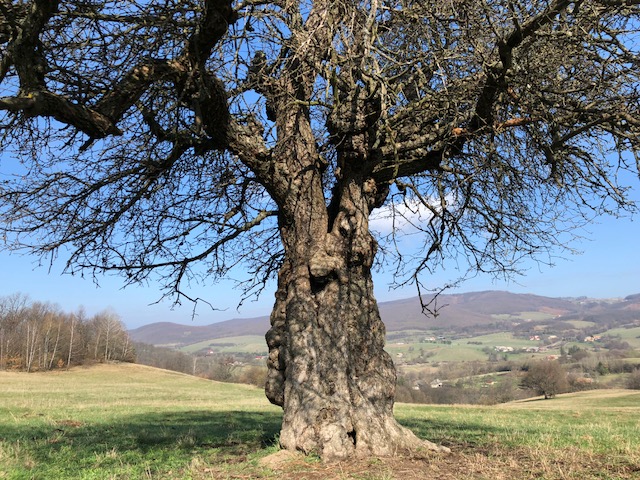
Then, something touched my cheek, gently. I lifted and turned my head, it was a branch of a tree that bowed in the wind. I looked up and saw a giant tree with scarred bark, it must have been centuries old or even millennia. I recognized that its mighty roots were coming out of the grave, with thin extensions entangled with parts of the bones. The tree had grown from the soil of the composted body of which the skeleton remained. The thought calmed me. I looked up again and saw that the tree was bearing a fruit. I had not seen this kind of tree or fruit before and did not know if it was edible or poisonous. But since I felt this emptiness in my stomach, I took the risk of plugging the fruit and ate it. It tasted bitter-sweet and made me fall into a long hallucinogenic sleep.

I woke up with the singing of a bird. It sat high up in the crown of the tree and sang its beautiful song. Through the song, quite to my surprise, it told a story from my great-grandmother. It was not an accurate story and not fully comprehensible. But it gave me a direction. Following it, I found an unknown path that unfolded under my feet while I walked it, leading me out of the darkness. And while I was walking towards the margins of the woods with my senses newly awakened, I saw that I had just stumbled over the edge of what appeared to be an endless cemetery. And I sensed that I was not the only human being in the forest. There were others who were digging and walking with me.

When I finally stepped out of the woods, the sun made me smile again.

Timo Holthoff, 13.08.2019


Engaged dis-identifications, NOTES#6: disburdening lack

1. Po-ethic inquiry: the genealogy of lack

In “Pedagogies of Crossing” (2005) Jacqui Alexander states that colonialism mutilates our visceral sense of entanglement.  This  dismemberment of our collective existence generates in its fragmented units “a yearning for wholeness, often expressed as a yearning to belong, a yearning that is both material and existential, both psychic and physical, and which, when satisfied, can subvert, and ultimately displace the pain of dismemberment” (p. 281). She suggests that strategies of membership in coalitions, like those of citizenship, community, family, political movement, nationalism and solidarity in identity or ideology, although important, have not addressed the source of this yearning. For Alexander, these coalitions have unintentionally reproduced the very fragmentation and separation that she identifies as the root of the problem. She states that the source of this yearning is a “deep knowing that we are in fact interdependent – neither separate, nor autonomous.” (p. 282). She explains:

As human beings we have a sacred connection to each other, and this is why enforced separations wreak havoc in our Souls. There is a great danger then, in living lives of segregation. Racial segregation. Segregation in politics. Segregated frameworks. Segregated and compartmentalised selves. What we have devised as an oppositional politics has been necessary, but it will never sustain us, for a while it may give us some temporary gains (which become more ephemeral the greater the threat, which is not a reason not to fight), it can never ultimately feed that deep place within us: that space of the erotic, that space of the Soul, that space of the Divine. (p. 282)

In this sense, the lacks that surface in society as personal experiences are symptoms of a more fundamental social fracture of separability. Separability creates a normative sense of separation of individuals from the land (earth metabolism). It extracts the intrinsic value of life creating a void that forces us to produce value in different economies to prove our worth and to have the reassurance that we deserve to be alive. Lack can only exist in separability. It manifests as compensation to the depletion caused by separability, where we try to fulfill ourselves with an ‘I’ that brings its individual compensatory (systemically designed) desires on physical, emotional, intellectual and spiritual levels.

2. Stretching spaces

  • Can you disburden yourself from lack?
  • Or it is about disburdening from its hold and power over you?
  • Can we unburden lack and its power over us?
  • Can we retrace the genealogy of lack?
  • Is lack a result of separability and/or is it the mechanism that reinforces it?

3. Nuancing affectabilities

Unburdening the inscriptions of lack created
by normative/hegemonic parameters of:

Body shape/size/beauty standard
sexual desire
gender performance
physical performance
intellectual performance
traditional family
romantic love
monogamy
aesthetic sensibility
linguistic intelligibility
affirmations of individuality
relations based on identification
conditional belonging

4. Incubating performative practices

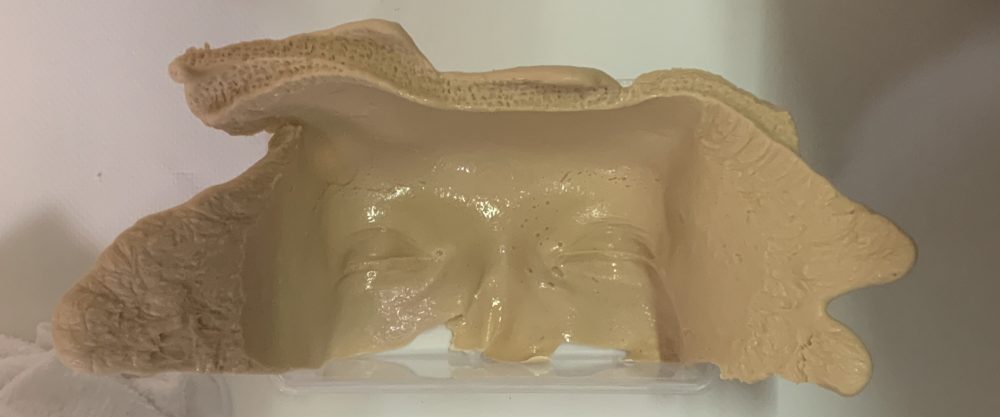
Form small clusters of people and experiment with a circuit of encounters through which a field of ancestrality can be created. Following the operations of contagious magic, in each encounter let bodies gift each other with forces they carry. Begin a journey of mapping the inscriptions of lack in your body. Enter through your eyes and scan your memories from within, travelling down to your feet and back up. Identify one of the inscriptions of lack and bring its teachings out with you, through your eyes. Following the operations of sympathetic magic, create a mould of your gaze, generating a double of this cosmovision of lack. Create a ritual to empty its powers over you.

Image credits:

Des-imunization Practices facilitated by  Dani d’Emilia and Fernanda Eugenio as part of the 4th edition of the AND_Lab summer school, in Polo Gaivotas (Lisbon).  Photos by Dani d’Emilia, Fernanda Eugenio and Joana Maia.

Engaged dis-identifications is an artistic-pedagogic collaboration between Dani d’Emilia and Vanessa Andreotti that explores the workings of non-notional possibilities of co-existence through performative practices. It attempts to translate post-representational modes of engagement into embodied experiments that reconfigure the connections between reason, affect and relationality.

Engaged dis-identifications, NOTES#9: we cannot not be together

1. Po-ethic inquiry: with/out modernity

How can we not turn our back to the multiple forms of violence that keep this system in place?

2. Stretching spaces

  • How do we not lose sight of what we don’t want to see?
  • What is it that our doings do in the world?
  • What colonial affective investments could be directing our thoughts and actions? In what ways do we account for the unsconscious in our practice?
  • How can we learn to decenter, to disarm and to discern?
  • How can we stop insecurities and projections from limiting possibilities?
  • How do we learn to let go of perceived entitlements and underlying desires that become a barrier to our ability to have difficult conversations and go into difficult spaces together?

3. Nuancing affectabilities

What do we need to lo(o)se(n), in order to experience…
ethics with/out the modern subject?
politics with/out the nation-state?
education with/out enlightenment?
welfare with/out capitalism… or socialism?
imagination with/out the intellect?
democracy with/out a single story of progress and reason?
humanity with/out good versus evil?
theology with/out an old man up above?
philosophy with/out Greece, the city or the alphabet?
psychoanalysis with/out the self?
dialogue with/out understanding?
justice with/out punishment?
hope with/out projections?
experience with/out self-actualization?
critique with/out righteousness, redeemers or virtue-signalling?
scholarship with/out posturing?
being with/out separability?
the end of the world as we know it without despair?

4. Incubating performative practices

During the ‘With/out Modernity Congress‘ a  series of artist/scholar talks and workshops invited participants to consider what infrastructures and architectures of knowing and being operationalize the denial of relational entanglement, foreclosing possibilities for orienting our existence otherwise.

Image credits:

Circles and Fishbowls held by various participants & Radical Tenderness and co(m)passion workshop, facilitated by Dani d’Emilia and Fernanda Eugenio as part of With/out Modernity: hospicing colonial habits of knowing and being, Congress held at University of British Columbia, 2-6 July 2019 (Vancouver, Canada).

Engaged dis-identifications is an artistic-pedagogic collaboration between Dani d’Emilia and Vanessa Andreotti that explores the workings of non-notional possibilities of co-existence through performative practices. It attempts to translate post-representational modes of engagement into embodied experiments that reconfigure the connections between reason, affect and relationality.

Engaged dis-identifications, NOTES#7: Excerpts of Repairing the Irreparable

Repairing the irreparable is a concept developed by Fernanda Eugenio as part of her work with the collective AND_Lab. It is a play on words from the portuguese term ‘reparar’, which encompasses various meanings such as re-stopping, re-attending, ie noticing as an inventory/invention practice, as well as repairing. This post is a collection of quotations and re-interpretations of a text originally written by Fernanda for the call to the AND_Lab summer school #4 (5-20th July 2019, Lisbon) in which Dani d’Emilia collaborated as a course co-designer and facilitator.

1. Po-ethic inquiry: Repairing the irreparable. Embodying political-affective practices, exercising sensitive listening and experimenting with the dissenting powers of love.

“[…]The irreparable, that which is implied in the irreversibility and unceasibility of any happening in itself, that throws us (in) the challenge of not withdrawing nor resisting, of not succumbing to indifference/impotence nor intransigence/attachment, finding, each time, the right measure of non-resigned acceptance, of co-responsive presence, of accompanying ourselves and each other in handling the emergent consequences of this unfolding, without appealing to narrative and creation of coherence, without intending to control.”

2. Stretching spaces

How do we move from a world-as-IS, through the (im)possibilities of embodying a world-as-WITH, engaging with a world-as-AND towards a world as nothingness/everythingness within-as-without?

“We wish to begin this delicate exercise of intimate-political curation by the tiny immensity of each participant; creating temporary zones of intimacy that may be less and less dependent on taste, choice, agreement, identification or understanding” […]

  • how to die together?
  • how to live alone?
  • how to kill oneself (parts of oneself/the System in oneself) without dying?
  • how to close the irreparable cycle of ow(n)ing – the deed-fact of colonial-capitalist looting – and (re)enter into the cycle of giving (oneself)?
  • How to liberate love and make it the force of liberation for the attention-reparation* of any relationship, recognizing that all our relationships are, in their own way, love relations (or that love is the form or the movement of relationships themselves)?
  • How to activate a loving struggle – this vigil without respite, this (im)possible and (im)precise navigation between complicity and reciprocity?
  • How to take courage and become an anc(h)ourage*?

* ‘anchourage’ is a term proposed by Fernanda Eugenio/AND_Lab, fusing the words/actions of anchoring and activating courage (translated from the original in portuguese ‘ancoragem’)

3. Nuancing affectabilities

How do we mobilize that stain we call love (which is at once diffused and already marked/worn) beyond human agency as:

a force of dis-immunization;
the realization of the ungovernable;
a mode of layered affectabilities;
a non-reactive modulation of civil disobedience;
an instrument of regeneration and collective curation;
an exercise of destitution, dispossession and unlearning of (self)oppressive behaviors;
an act of attunement by intersection and obliquity, by the improper and the extraneous;
a bond of strangership;
a way of welcoming the inevitable discomfort implied in the stretching of the possible, the thinkable and, above all, of the feelable;
a gesture of accompaniment in the risk, and of support of the unknown-unknowable;
a practice of simultaneously giving (oneself) and continuing to have;
a committed training in the de-hierarchization of attention;
a situated practice of fairness and sufficiency;
a way of resumption of the expropriated territories of vital,  invisible and sensitive forces and vocabularies;
a combining and embracing of the contradictions of both questioning the habitual contours of the notion of intimacy/privacy (their aspects which reproduce the logic of private capitalist property) and the affirmation of the (accountable) autonomy of the individual and collective bodies and their immanent rules, of their inalienable right to fractal uniqueness, entangled wholeness, nothingness and constant (re)invention;
as a visceral responsibility and renounciation of unrestricted autonomy.

4. Incubating performative practices

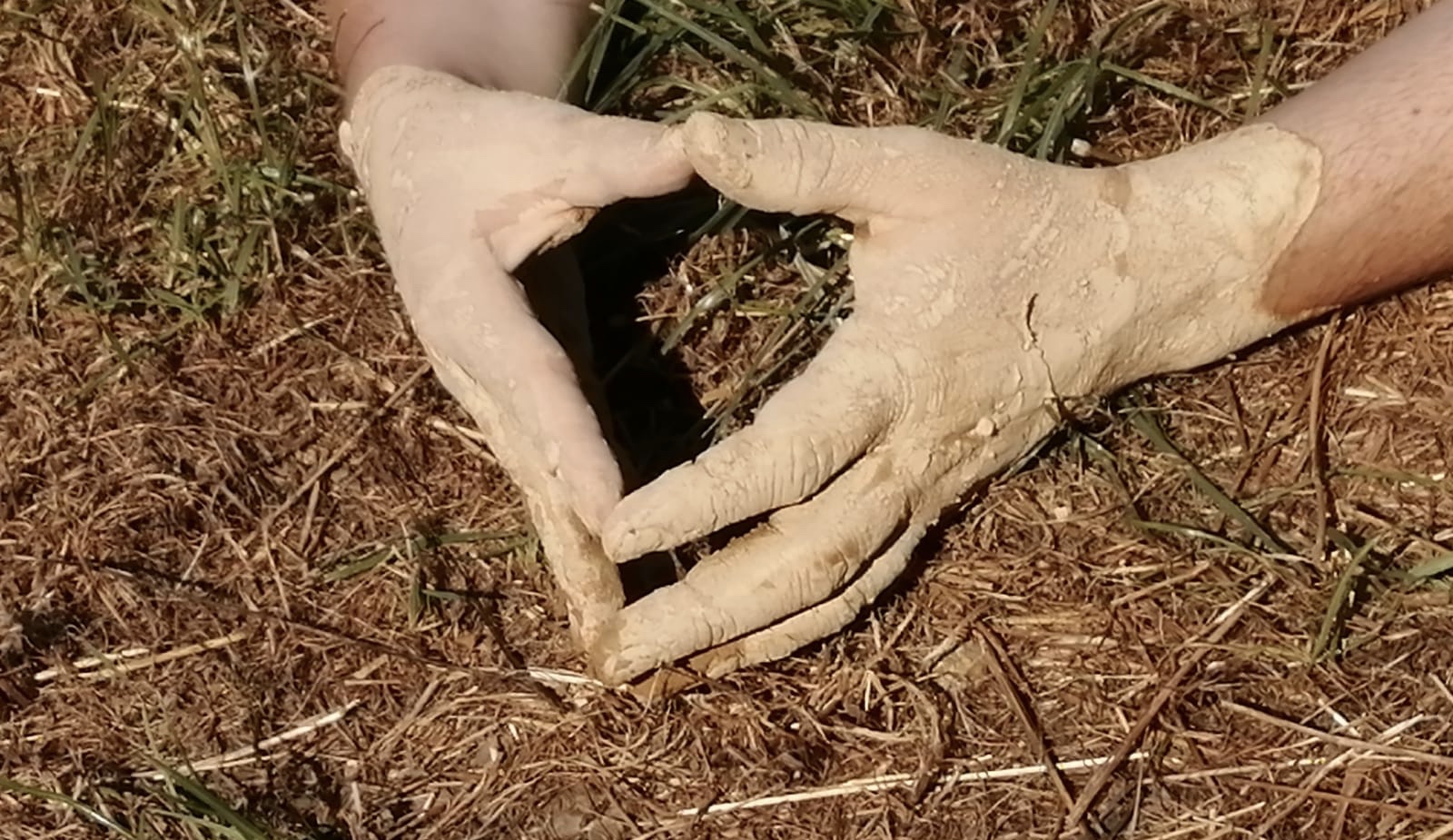
[After a series of previous exercises] find yourself holding hands with a partner. Pour glue over yours joined hands. Go for a half hour silent walk together, a duet-derive, around the neighborhood. Give loving attention to all the details of the negotiations that become necessary between the two of you (direction, speed, focus, etc), and how you perceive the external gazes that cross your path (this may feel very different according to context, as well as couple configuration). Notice the affects that arise in you, practicing non-attachment as well as non-rejection of them. Return to the workshop space. Sitting across from each other, engage in a joint re-telling of the journey, sharing the narrative amongst each other, starting from when you left the room and finishing when your arrived back. Each time you speak, peal a section of the glue membrane holding your hands together. Stop speaking/pealing whenever you wish, and let your partner continue from where you left it. Try to always continue the narrative from the point where the previous person stopped, not falling into the temptation of correcting or adding details to parts that have already been spoken of. Try to time the pealing of the membrane with the end of the narration of the journey. Notice the affects that arise in you in this process,  practicing non-attachment as well as non-rejection of them.


* This exercise was initially inspired by a handheld derive experienced in a workshop series by Lisbon based dancer Catarina Vieira (Matéria, in which Dani collaborated in 2018) and by the glued hands used as synthesis-image for the Exhibition-Occupation AND in Porto, event where the proposition was first developed by Dani d’Emilia and Fernanda Eugenio (AND_Lab), as part of their collaboration Des-imunization Practices.  More images of these and other practices proposed in the AND_Lab Summer School #4 are accessible here.

Image credits:

Des-imunization Practices facilitated by  Dani d’Emilia and Fernanda Eugenio as part of the 4th edition of the AND_Lab summer school, in Polo Gaivotas (Lisbon).  Photos by Fernanda Eugenio and Ana Dinger.

Engaged dis-identifications is an artistic-pedagogic collaboration between Dani d’Emilia and Vanessa Andreotti that explores the workings of non-notional possibilities of co-existence through performative practices. It attempts to translate post-representational modes of engagement into embodied experiments that reconfigure the connections between reason, affect and relationality.