

Po-ethic inquiry #7: broken bones


On the fantasy-shelf of diversity, a collection of DOLLS on display.
Each doll with a TRY ME button: press it and she will say exactly what you always wanted to hear.
Buy one, get one free… They will forever be thankful to you!


AVAILABLE DOLLS:
Model minority:
“Don’t we look great (in the equity photo), Sir?”
Revolutionary:
“I will redeem you.”
Alibi friend:
“You are definitely NOT a racist!”
Cultural artifact:
“What would you like to know about me and my culture?”
Toilet cleaner:
“Always at your service, Madam!”
Child waiting to be rescued:
“Thank you for supporting me!”
ALREADY SOLD OUT:
Room ornament:
“I will keep myself small so that you can have space”
Music box ballerina:
“I am here to dance to make you feel wonderful”
Erotic diva:
“Ready for your most exotic fantasies!”
Piece of clay to be molded:
“Who should I be today to fit your agenda?”
Angry trouble maker:
“I will call it out and take the flak, so that you don’t have to.”
Your soul mate:
“You are white just on the outside, inside you are just like me.”
…cross the line, challenge the rank, reject the projections or dare reverse the power relationship and to the trash the threat must go.
Another doll bought in your place, after all, you are cheap.
The market is flooded with plastic merchandise: a mosaic of colourful bodies kept in place with white glue, many waiting impatiently to be on that shelf.
I was NOT born to please you,
to entertain you,
to be cared, praised or pitied by you
The reason for my existence
is NOT to make “you” happen,
to prove your innocence or to make the world better for you
My body is NOT an extension of your entitlements
Neither is yours of mine
I don’t want to hurt you,
to haunt you, to intimidate you,
to harm you, or to compete with you.
You cannot demand that I teach you,
that I help you, that I convince you,
that I serve you, or that I make you feel
what you hope to feel.
I just need to BE what I need to BE
Without having to negotiate these freaking boxes all the time
And I want the same freedom for you
But this freedom is not the same as unrestricted autonomy
Because it involves unlimited accountability
And that means I cannot tell you who to be or what to do because
upon respecting your existence depends
the integrity of my own
I wait for your readiness,
in this life, in this world,
to not turn your back to the responsibility
for facing and working through
the individual and collective shit
that prevents us from breathing together
—

What do we need to lo(o)se(n), in order to experience…
ethics with/out the modern subject?
politics with/out the nation-state?
education with/out the Enlightenment?
welfare with/out capitalism… or socialism?
imagination with/out the intellect?
solidarity with/out heroism?
democracy with/out consensus or a single story of progress and reason?
humanity with/out good versus evil?
criticality with/out dialectics and essentialism?
theology with/out an old man up above?
philosophy with/out Greece, the polis or the alphabet?
psychoanalysis with/out the self?
queerness with/out identity?
dialogue with/out understanding?
community with/out conditionality?
justice with/out punishment?
hope with/out projections?
experience with/out self-actualization?
critique with/out righteousness, redeemers or virtue-signalling?
scholarship with/out posturing?
academic rigor with/out the cannon?
knowing with/out meaning?
time with/out linearity or motion?
space with/out location or place?
being with/out separability?
existence with/out form?
the end of the world as we know it without despair?
—
Image credits: Me livro do que me pesa, photo-performance by Dani d’Emilia. Brasil, 2011. Image by Angela Alegria

RADICAL TENDERNESS is practicing attunement
It is listening to collective unuttered wisdom, nurturing intrinsic, rather than productive value
It is engaging with each other beyond desires for consensus, coherence and control
It is dancing beyond the loop of identification and dis-identification
It is letting go of possessions, of possessiveness
It is feeling part of a wider metabolism with a much longer temporality
It is queering time
It is setting what matters in the time when we no longer inhabit this body
It is to be sense-full, to allow our state of wondering to stay open, without always trapping it into meaning
It is not holding “being” hostage to “knowing”
It is presencing what we don’t know, what we can’t know, and what is unknowable (in ourselves and in others)
It is quieting the narrativization of the world and enjoying silence with each other
RADICAL TENDERNESS is being receptive to the teachings of our shadows
It is fermenting ourselves, mourning illusions, composting our shit
It is balancing the use of our pre-frontal cortex and our pineal gland
It is looking in the mirror and confronting what is not beautiful without
turning the gaze
It is disinvesting in arrogance, superiority, and status
It is to embrace oneself as both cute and pathetic
It is being courageously vulnerable
It is knowing that we pee, we poo, we cry and we puke
It is about being the ocean, watching the waves
It is going beyond projections and compensations
It is decentering, disarming, decluttering, discerning, deflattening
It is not being afraid of fear, disapointability, or nothingness
It is discovering a whole bus of people inside oneself
It is not casting upon everything a blanket of interpretation
RADICAL TENDERNESS is engendering new forms of co-existence
It is engaging through artful participation
It is respecting different medicines and working through affinities and differences
It is tuning in with, not just empathizing with
It is witnessing ourselves and each other moving between our comfort, stretch and panic zones
It is knowing that people can begin to heal when they are heard
It is breaking the cycle in which people with trauma are demanded to share their stories in order to be validated
It is ‘mandar obedeciendo’, as the zapatistas say
It is relating beyond identity, knowledge and understanding
It is dissolving the limits and weight of our bodies by allowing others to move through, with and for us
RADICAL TENDERNESS es el dolor de traspasar el corazón (or the pain of piercing the heart)
It is turning the heart into a verb: corazonar, senti-pensar
It is neither me nor you, it is me and you, me in you
It is not about belonging, it is about being whole with the whole shabang
It is not either or, but both and more
It is looking at painful and difficult things with the love of really wanting to see
It is tending the wounds created when the skin holding one body stretches and tears in order to receive and be refigured by another
It is learning from repeated mistakes in order to only make new ones in the future
It is listening to the non-human authority, and caring about our relationship to it
It is about being open to what we can’t and may never understand
It is conditioning the muscles that enable neurogenesis
It is learning to breathe water together
Radical Tenderness is to practice engaged detachment as we hospice a dystopic world …while respecting the teachings it offers
Radical Tenderness is assisting with the birth of something new, which is potentially, but not necessarily, wiser…without suffocating it with projections
RADICAL TENDERNESS is being critical and loving, at the same time
RADICAL TENDERNESS is appropriable and ever-changing
______________________________________________________________________
Book review: Against Purity: Living Ethically in Compromised Times (2016) by Rosalynd Boxall, comments by Sharon Stein
In Against Purity: Living Ethically in Compromised Times (2016), Alexis Shotwell rethinks common tendencies within anti-oppressive critiques and political practices that seek moral purity and certainty about alternative futures. Instead, she imagines how complexity, complicity, and uncertainty might serve as the starting point for ethics and action.
Against Purity: Living Ethically in Compromised Times by Alexis Shotwell offers a rich and complex platform for imagining ourselves, our past, and crafting a future otherwise. In doing so, it presents new ways forward for thinking through the complexities, ambiguities and uncertainties of the current historical moment. Published at the end of 2016, a year when many of our expectations, hopes, and assumptions about the world-order were turned on their heads (or perhaps, things we already knew to be true were affirmed, for example, the racism that was stoked by Brexit and the election of President Trump), Shotwell’s book appears particularly timely. We are in a historical moment filled with uncertainty, fear, and turbulence, but also a reaffirmed commitment to crafting different futures (for example, the organising efforts that followed the election of Trump in the US, and the increased political engagement of young people in the British general election following Brexit). As the fiction author Kitty Chandler tweeted in January last year, “The Year is 2017. America is a tire fire. The resistance is led by Teen Vogue, Badlands National Park, and the Merriam-Webster dictionary” (@mightybattlecat, 24 Jan 2017). A year onwards these predictions seem remarkably apt and Shotwell’s work feels particularly relevant.
Against Purity is organised into three parts: Reckoning with a Fraught Past; Living in an Interdependent Present; and Shaping Unforeseeable Futures. The structure of the book warrants comment: at first glance it seems to follow a linear, teleological trajectory (each section corresponds to past, present, and future respectively). But, as Shotwell shows (and this indeed is a central part of her whole argument), the past involves both the present and the future; the present engages both the past and possible futures; and the future relies on the past and is made possible within an ever-shrinking present time: ‘The past involves the present and the future, the present entangles the past and outlines what is to come, bringing the future into the past, and the future rests on a situated past and can only ‘happen’ in the present; tense intermingles’ (16). This is potentially a fruitful lens for grounding discussions of the future, and engaging/implicating history and the present in these discussions. However, if read within a purely western temporal ontology we run the risk of producing only circular futures if we mis-understand Shotwell’s claim that ‘the future’ as something only made possible within an ever-shrinking present moment, and an ever-increasing accumulation of past events. Thinking through her methodology may be a productive way to approach the challenge of how to structure and articulate critiques of existing proposals for different futures; examining how she works through and beyond standard narratives to expose, explore, and generate meaningful and transformative relations with the past, present, and future.
Shotwell draws together a variety of ethico-onto-epistemic challenges produced by modernity within the praxis of responsibility and relationality. Using the themes of ‘classification’ and ‘healthism’ to disrupt the moral binary of ‘good’ vs. ‘bad’ health (both in the classic sense of sickness and disability, but also to disrupt assumptions about ‘modernity’ vs. those ‘lacking’ or unable to catch up to modernity). As she shows, when we link classification, healthism and morality, those deemed to be ‘morally inferior’ people or groups can easily be declared ‘undeserving’, thus justifying their subjugation, exploitation and brutalisation by the ‘dark side’ of modernity, i.e. colonialism. We see that purity is co-constituted as both a meta-physical and onto-epistemological concept, with material/physical realities. She argues for the concomitant existence of an ontology of embodiment and entanglement, and the necessity and complicity of interdependence and co-constitution. Significantly, she argues that this is our way of being whether we acknowledge it or not, although this is experienced differentially for different peoples and groups affected by colonialism.
Moving chronologically through the book, Shotwell explores the role of settlers in taking responsibility for the wrongs of colonialism, particularly through the lens of residential schooling and in light of the Truth and Reconciliation Commission (TRC) in Canada. In her chapter Women Don’t Get AIDS, They Just Die From It, she explores how the US Center for Disease Control and Prevention (CDC)’s classification of the disease worked to exclude women from AIDS diagnoses (and thus, care and disability benefits), dwelling on HIV/AIDS activism and its complexities, and concepts of individual and collective memory (the relationality of remembering). In Part II she explores the socioeconomic distribution of pollutants and toxins, and the co-production of race, ability and heterodoxy, deepening her critique against classificatory oppression. The final section argues for ‘relation’ as the smallest unit of analysis available to us. Building on her earlier analysis of complicity and complexity, she articulates the need for a co-produced freedom and future, and for understanding that some of us live the comfortable lives we do because of the immiseration of others, not by coincidence. She concludes by moving beyond the epistemic through activist work as a means for change.
Shotwell invites her readers to consider: what might be possible if we began from the fact of impurity, that is, from the fact that “There is no food we can eat, clothing we can buy, or energy we can use without deepening our ties to complex webs of suffering”? In asking such questions, she does not flatten uneven complicities in harm, or excuse these harms because they are so insidious and overwhelming, but rather emphasizes the futility and colonial circularity of pursuing a place of innocence from which to act: “People are not equally responsible or capable, and are not equally called to respond. But however the bounds of the ‘we’ are drawn, we are not, ever, pure. We’re complicit, implicated, tied in to things we abjure. This is a kind of impurity implied in the sense of ‘compromised living’ that involves making concessions” (6-7)
It is worth defining a few terms here before moving on: for Shotwell, healthism is the tendency to think about individual health as moral imperative; individuals are held responsible for their health and poor health is rendered as a moral failing. Healing (for example, that expected of Indigenous survivors of residential schooling) is thus expected to be an individual exercise, even in contexts of collective harm. It is easier to define what purity is not than define exactly what it is. To be against purity is not to be for harm, sickness, pollution etc., but ‘to be against the rhetorical or conceptual attempt to delineate and delimit the world into something separable, disentangled and homogeneous’ (15). Shotwell’s articulation of purity and purity practises ties into myths of ontological security that is offered by a colonial mode of existence. As Shotwell explains, purity as an ontological orientation is necessarily a fragile fiction; a conceit under constant but disavowed threat. To affirm a commitment to purity is to disavow the entanglement and co-constitution (the impurity) of everything, and to pretend in turn that the world is separate and unconnected. This then enables one to believe that the wrongs and violences of modernity are unconnected and unrelated to its privileges and ‘shine’. Indeed, Shotwell presents purity as essentially modern; arguing that modernity presents itself as pure even if it is not pure at all, and despite the impossibility of it ever achieving that purity (14). Following Maria Lugones, Shotwell quotes that the modern ‘man of purity’ ‘shuns impurity, ambiguity, multiplicity as they threaten his own fiction. The enormity of the threat keeps him from understanding it. So, the lover of purity remains ignorant of his own impurity, and thus the threat of all impurity remains significantly uncontaminated’ (Lugones, 132, 2003). Shotwell is against purity without predicting or prescribing (and thus limiting) the many things there are to be for; this ‘no’ ‘opens the space for many yesses’ (19).
I will briefly summarise each chapter, attempting to draw out some of the broader themes (relationality, responsibility, purity, disability, classification, colonialism, etc.) that guide her analysis throughout. Possibly as a result of my orientation as a historian, I found the points raised in Part I particularly resonant. Reckoning with a Fraught Past connects the past with both the present and the future, arguing that any reckoning with the past that we carry in our present involves reckoning with the ‘colonial ghosts’ in our bones. Shotwell argues for a relationship between memory practises, categories of classification, practises of colonialism and racialisation. She shows how classification was co-produced with practices of colonialism (particularly around residential schooling), and indeed, is a central technology of colonialism. Arguing that when classifications work well they become infrastructure, shaping social relations that appear common-sensical, rather than violently and deliberately constructed. This naturalisation and invisibilisation imbricates with purity politics and the social organisation of forgetting. She posits political forgetting as an epistemology and an ontology, arguing against the idea that we face a ‘knowledge problem’. ‘We don’t just have a knowledge problem – we have a habit-of-being problem; the problem of whiteness is a problem of what we expect, our ways of being, bodily-ness and how we understand ourselves as ‘placed’ in time’ (38). This forgetting enables us to stage a false dichotomy between the harmful ‘then’ practises of colonialism (presumed to be past) and a pure and clean ‘now’, meaning processes like the TRC can address themselves to the historically and socially bounded wrong of residential schools without reckoning or implicating Canada in the entire history of colonialism and its ongoing violence. Drawing on Sue Campbell’s relational theorising of memory practises, Shotwell argues that reckoning with the social organisation of forgetting helps us craft a future different from the horrific past we have collectively inherited and differentially live in the present. She follows Campbell’s notion of forward looking memory/forward looking responsibility as a politically transformative way forwards – repeatedly making ourselves accountable to clean up messes in which we might not be directly involved, but that through our very existence we are complicit with (49). She concludes this chapter by asking how settlers ought to stand in relations of forward-looking responsibility without attempting to stand in the place of Indigenous people (52).
Shotwell raises many generative questions without prescribing the answers, such as: “What would responsibility for the future look like, as a collective practice of producing the conditions for flourishing (rather than the narrow conception of individual health)? What would it mean for the Canadian state to take responsibility and attempt to redress harm not merely for the wrongs of forced residential schooling, but for the histories and ongoing practices of colonization? What could it mean for resurgence from harm to arise without reference to the Canadian state?” (35)
Shotwell puts these theories into practise in the second chapter, Women Don’t Get AIDS, which details the activism of the ACT UP Women’s Caucus to change the CDC definition of AIDS-defining illnesses, which had historically excluded many of the opportunistic infections experienced by women living with HIV/AIDS, thus excluding them from recognition/diagnosis, and thus from medical and social supports and benefits, with real material affects for how these women lived and died. Through these material and social effects Shotwell shows how practices of memory and classification that have become naturalised and invisiblised can dramatically shape peoples’ lives and futures. She counters this by arguing for us to attend to how we remember the past, to consider how and why we remember, and recognise these memory practises as situated and invested rather than natural and inevitable (62). Through this case study Shotwell demonstrates how we can expose and circumvent narratives that have already become naturalised (faded out and become infrastructure) to the point that it is difficult tor recall when and how they were created (and contested); attending to this contestation reminds us that what happened in the past was not inevitable, and that no particular future is inevitable either. Although she is referring specifically to the CDC definition of AIDS, there are broader theoretical parallels with the entire construction of western modernity and colonialism that can be drawn out here.
Part II: Living in an Interdependent Present shifts us away from the past to the present moment, as a ‘continually receding seed for the future: whatever happens now shapes the conditions for what can happen in any given then’ (77). In Shimmering Presences: Frog, Toad, and Toxic Interdependencies she focuses on this ‘toxic’ present through a lens of queer and racialised temporalities, practises which she argues enable us to be in the present with relation to the past and a future offset from narratives about the normalising progression of subject formation and accumulation of capital. Although moving away from the emphasis on relational remembering, Shotwell still draws us back to the idea of relational responsibility, arguing for us to cultivate practises of responsibility for the toxic present we are implicated in creating, and practises of perceiving interdependence that nourish ethical relations to the complex ecologies in which we are implicated and through which we are formed. Again focusing on a specific case study she demonstrates how the rhetoric (and practise) of bioscience (examining sex changes in frogs and toads in response to environmental changes) can (inadvertently) reinforce harmful tropes of sexuality, sex, gender and disability. Specifically, she shows how some efforts to take responsibility for the toxic present rely on anti-disability or trans-antagonistic tropes. In response, Shotwell calls for us to attend to the present to create a more complex, less predictable narrative (again circumventing naturalised and invisibilised dominant narratives), arguing that ‘we need to make different agential cuts that allow us to generate different narratives and different nodes of attention’ (106).
In Chapter Four, Consuming Suffering: Eating, Ethics, and Embodied Ethics, Shotwell applies a relational lens to discussions about food and eating in our current context of climate change and toxic environments. She questions what the embodied experience of recognising ourselves as impossibly situated in interdependent relationships of suffering is like. Arguing that to be embodied is to be placed, sustained, affected by the world, and in turn affect the world, she explores the ethical demands that this implies (107), and offers a grounded discussion of concepts which can often seem overtly lofty and theoretical (and thus obscure their relevancy and immediacy in discussions about climate change and the future), including biocapital and biovalue. This chapter would hold value brought together with discussions about environmentalism, climate change, and the future.
Part III: Shaping Unforeseeable Futures weaves together issues of racialisation, disability theory and gender-based oppression, offering more concrete engagement with ideas of collective action and change to help craft different futures that are only accessible from our damaged present (while still seeking to avoid the unsupported yet urgent imperatives so prevalent on the left/in the genre of future writing, ‘we need’, ‘we must’). In Chapter Five, Practising Freedom: Disability and Gender Transformation, Shotwell offers the concept of ‘open normativities’ as a way of thinking about ethics as collective action and political projects grounded in relationality. As its name suggests, Chapter Six, Worlds to Come: Imagining Speculative Disability Futures, fills out the discussion of collective action and ideas about how we might create a better world within a complex and imperfect present. This section draws heavily on Donna Haraway’s conceptualisation of SF (science fiction, speculative fabulations, scientific facts). Shotwell concludes this section by reminding us that the future is always in dialogue with the present, arguing that ‘the new world we carry in our hearts is always a world grounded in the actually existing present in all its impurity, responsible to the past in all its complexity’ (193).
This book is teeming with intelligent passion, self-critique and self-reflection, compassion, knowledge and an urgent decolonial agenda (potentially more accurately described as a de-modernity agenda). It is difficult to offer a broad, sustained critique of any one aspect of the book, although the final section on imagining the future is perhaps most easy to critique purely by its nature; attempting to ‘imagine the unimaginable’ is always a fraught exercise, if at times also a useful one. Although this book offers a pretty damning critique of modernity, and our current strategies and tools for responding to the past and present so that we might attend to different futures with less harm and ‘more flourishing, Shotwell’s argument is deceptively optimistic. By affirming that although we live in a world full of complexity and suffering, where we are all (unevenly) complicit, there is space to craft better futures. In coming to terms with this (as Shotwell writes), we might find hope is also going to have to be an everyday practise (10).
Shotwell asks her readers to consider what “forward-thinking responsibility” might look like if we understood ourselves as entangled with each other and the world, before will, and derived our sense of responsibility and political action from there?
By Sharon Stein and Vanessa Andreotti
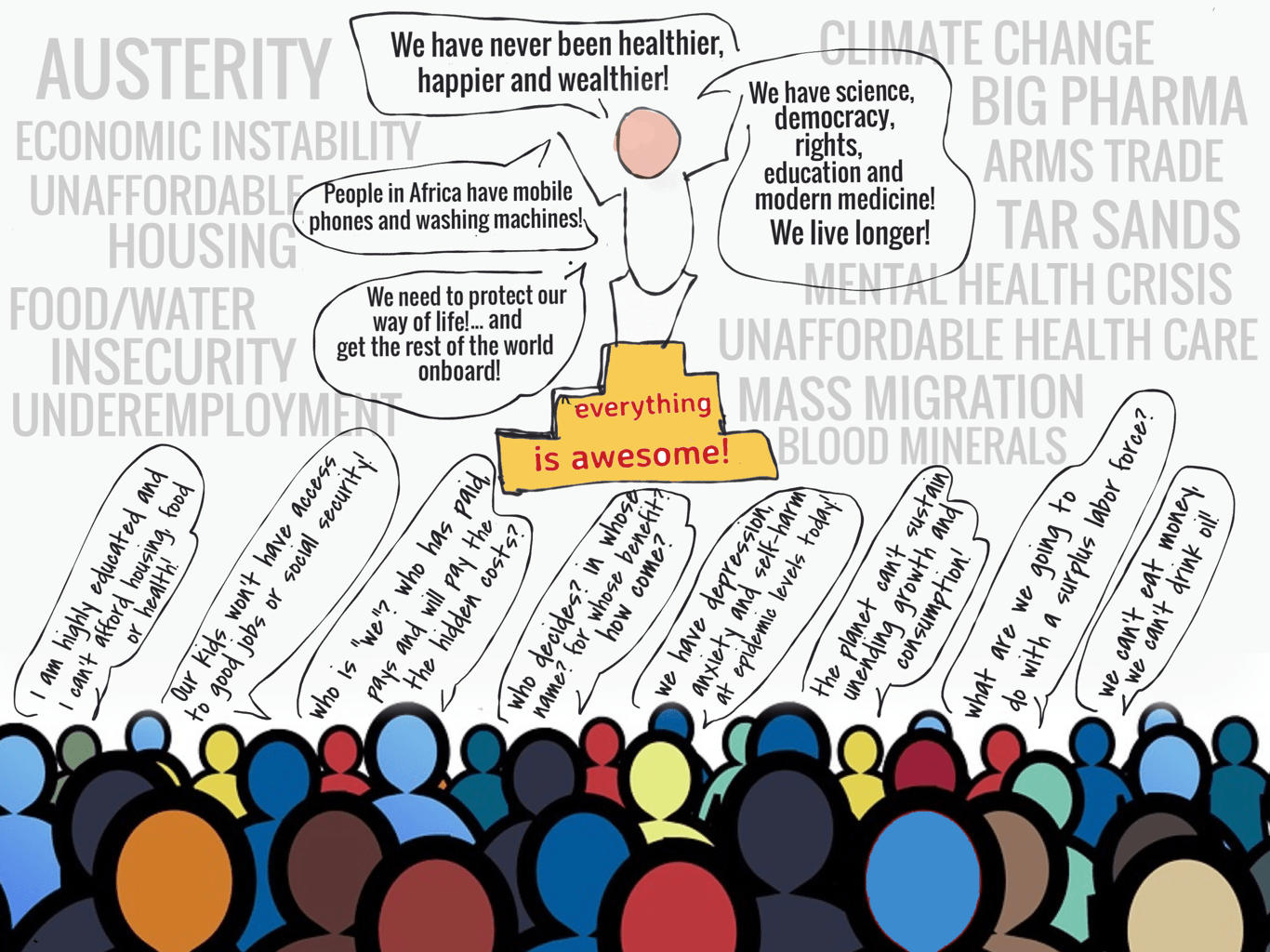
The following cartography was inspired by an international education conference that we recently attended. When we first learned that the conference theme was entitled, “Things we should be talking about in international education,” we were excited about possible openings for the kinds of reflexive, complex, and difficult conversations that we had been advocating for in the context of international education. The conference invitation noted about the international education sector:
“Our sector casts a long shadow and there may be other things we should be talking about: climate change and the culpability of our sector with its large carbon footprint; how globalization and its well-intentioned offspring internationalization have spawned the populism and nativism we are so offended by; fake news and the abhorrent lack of inculcation of critical thinking; how cosmopolitanism, inter-culturalization and indigenization have on the streets already overtaken internationalization as prima facie rationale for what we do; housing, mental health, campus suicides, student support and stewardship; culture, sexual assault and predatory behaviour; nature vs. nurture and male violence, the great majority of which is directed towards other males; regional growth and rural engagement; our addiction to unsustainable growth; reconciliation and residential schools; fentanyl, opioids and binge drinking; our complicity in the brain drain, the scourge of globalization; our culling of the top economic strata from the global South’s burgeoning middle classes (our emerging markets) to fill our classrooms, quotas and coffers; our wilful ignorance of the demography and elitism of study abroad, building programs and pedestals for the 1% to springboard their careers.”
While this text and the tone of the conference’s opening session gestured toward pressing ecological, economic, and political challenges, and the potential for international education to either mitigate or worsen these challenges, by midday the orientation of the conference turned sharply toward emphasizing unprecedented levels of wealth and well being, with the only perceived challenges being the possible interruption of the continued spread of this good news gospel and its accompanying material gifts. This tone continued with the keynote presentation of a prominent Canadian politician.
The tone of the keynote sounded eerily like the “Everything is awesome” song from the Lego movie, also echoing a refrain that has also been recently articulated by those seeking to reframe a seemingly endless stream of bad news and concerned assessments about the many challenges of the present.
Perhaps the most well known of these recent texts is Stephen Pinker’s Enlightenment Now, which Bill Gates has declared as his “new favorite book of all time.” From the book publisher’s description, in this book, “Pinker shows that life, health, prosperity, safety, peace, knowledge, and happiness are on the rise, not just in the West, but worldwide. This progress is not the result of some cosmic force. It is a gift of the Enlightenment: the conviction that reason and science can enhance human flourishing.”
While for some this text is a welcome intervention, it has also been met with a series of critical responses. With this image, we offer a pedagogical cartography of responses to the assertion that “everything is awesome”, through which we seek to invite active engagement with the blindspots of this assertion in ways that might supplement the more point by point accountings of its inaccuracies and oversights. To illustrate the possible uses of this cartography, in addition to the image itself, we offer a series of possible guiding questions for educational engagement around the issues it addresses.
The image shows a speaker on a podium making declarations about the overwhelmingly positive state of the world, while voices below him raise various concerns that contest his depiction of reality. This is not meant to be a comprehensive representation of all possible responses, but rather a selection of replies that would likely be most legible, if perhaps disagreeable, to the speaker. Indeed, there are many more voices that would likely be unintelligible to the speaker. One way to engage people around this image in a way that extends and complexifies what is already represented, might be to ask:
Similarly, the list of disavowed issues that surround the speaker is hardly comprehensive, so it can be generative to ask which issues are missing, and which are the most important in their own context.
By creating an opportunity to ask where different positions come from, what they presume, where they lead, what they enable, what they foreclose, and which positions remain absent or invisibilized, social cartographies can challenge presumptive authorities without either seeking to replace them with a different authority or advocating an absolute relativity of positions. Further, by challenging learned desires for consensus, coherence, and quick resolution, cartographies can help build the stamina that is necessary to sit with the contradictions, complexity, uncertainty, and ambivalence that are involved in learning and unlearning ways of knowing, being, and relating with and in the world. Ultimately, rather than prescribe solutions, this supports people to make their own (better informed) decisions about how to respond to complex global challenges within their own situated contexts.
Download picture here.

The text below emerged from the experiences of many bodies who have been systemically impacted by the violences of colonialism.
As a living text, it calls us to welcome a thunderstorm ancestor coming with heavy rain, and teenage and elderly winds that can help us move to a different space in our relationships, perhaps opening up possibilities for new forms of co-existence.
We invite you to create a quiet space to hold the text and request close to your heart for a while and to witness your own responses to the rain and the wind.
If you feel moved, please share what you have learned or felt below in any form you like. You may also be asked by the thunderstorm to contribute extra verses or write another version of the text.
don’t do it for charity, for feeling good, for looking good, or for showing others that you are doing good
don’t do it in exchange for redemption from guilt, for increasing your virtue, for appeasing your shame, for a vanity award
don’t put it on your CV, or on facebook, or in your thesis, don’t make it part of your brand, don’t use it for self-promotion
don’t do it as an excuse to keep your privileges, to justify your position, to do everything except what would beactually needed to change the terms of our relationship
do it only if you feel that our pasts, presents and futures are intertwined, and our bodies and spirits entangled
do it only if you sense that we are one metabolism that is sick, and what happens to me also happens to you
do it recognizing that you have the luxury of choice to participate or not, to stand or not, to give up your weekend or not, whereas others don’t get to decide
don’t try to “mould” me, or to “help” me, or to make me say and do what is convenient for you
don’t weaponize me (‘I couldn’t possibly be racist’)
don’t instrumentalize me (‘my marginalized friend says’)
don’t speak for me (‘I know what you really mean’)
don’t infantilize me (‘I am doing this for you’)
don’t make your actions contingent on me confiding in you, telling you my traumas, recounting my traditions, practicing your idea of ‘right’ politics, or performing the role of a victim to be saved by you or a revolutionary that can save you
and expect it to be, at times, incoherent, messy, uncomfortable, difficult, deceptive, contradictory, paradoxical, repetitive, frustrating, incomprehensible, infuriating, dull and painful – and prepare for your heart to break and be stretched
do you still want to do it?
then share the burdens placed on my back, the unique medicines you bring, and the benefits you have earned from this violent and lethal disease
co-create the space where I am able to do the work that only I can and need to do for all of us
take a step back from the center, the frontline from visibility relinquish the authority of your interpretations, your choice, your entitlements, surrender that which you are most praised and rewarded for
don’t try to teach, to lead, to organize, to mentor, to control, to theorize, or to determine where we should go, how to get there and why
offer your energy to peel potatoes, to wash the dishes, to scrub the toilets, to drive the truck, to care for the babies, to entertain the kids, to separate the trash, to do the laundry, to feed the elders, to clean the mess, to buy the food, to fill the tank, to write the grant proposal, to pay the tab and the bail
to do and support things you can’t and won’t understand, and do what is needed, instead of what you want to do, without judgment, or sense of martyrdom or expectation for gratitude, or for any kind of recognition
then you will be ready to sit with me through the storm
with the anger
the pain
the frustration
the losses
the fears
and the longing for better times
with each other
and you will be able
to cry with me
to mourn with me
to laugh with me
to “heart” with me
as we face our shadows
and find other joys
in earthing, breathing, braiding,
growing, cooking and eating,
sharing, healing, and thriving
side by side
so that we might
learn to be ourselves
but also something else
something that is also
you and me
and you in me
and neither you nor me


house mycelium mini-zine pdf (v. 3.1 updated 29.06.2018)
house mycelium text pdf (updated 02.07.2018)
Video on how to fold the mini-zine:
From the house that modernity built to healthy mycelium
This mini-zine is a pedagogical experiment that invites conversations about our collective existence in a planet facing unprecedented crises. These conversations change the zine as well, therefore there are many different versions of it (like a palimpsest). We are interested in the conversations that are mobilized by the mini-zine rather than in getting the descriptions/representations right. What we present is one of many possible diagnoses and propositions.
The mini-zine presents two cartographies that comprise a theory-of-change. Every theory of change is made up of a diagnosis of the present, and a proposition about a horizon for change. On one side of this mini-zine there is a diagnosis (the house), on the other side, the proposition for a horizon and for a way of moving together (mushrooms and mycelium).
Each side of the zine presents a different social cartography. On one side, the social cartography “The House Modernity Built” offers a diagnosis of the present focusing on a modern/colonial global imaginary in which being is reduced to knowing, profits take precedent over people, the earth is treated as a resource rather than a living relation, and the shiny promises of states, markets, and Western reason are subsidized by the disavowed harms of impoverishment, genocide, and environmental destruction. On the other side of the zine, the social cartography “In Earth’s CARE” invites conversations about the possibility of setting horizons of hope beyond the house that modernity built. Through an earth centered metaphor, it proposes that ecological and economic justice (mushrooms) are not viable without cognitive, affective and relational justice (healthy mycelium). Together the social cartographies point to the need for a different kind of education where we see ourselves as part of a wider metabolism and where we learn to hospice modernity, learning from its recurrent mistakes, in order to open our imaginaries and make only new mistakes as we assist with the birth of something new, undefined, and potentially, but not necessarily, wiser.
The house modernity built
The social cartography “The house modernity built” was inspired by Audre Lorde’s famous insight that
“… the master’s tools will never dismantle the master’s house. They may allow us temporarily to beat him at his own game, but they will never enable us to bring about genuine change.”
The first four frames at the top of the cartography present a brief analysis of contemporary social structures and institutions facing social, political, ecological and economic crises. The four frames at the bottom of the cartography offer an analysis of how modernity affects our reasoning, our sense of self and reality, our desires, and our perceived entitlements, impairing our capacity to feel, to hope, to relate, and to be and imagine differently.
This cartography synthesizes critiques of modernity that have been mobilized in Indigenous, Black, and Decolonial practices and studies, Post-development and Post-colonial theory, and (different forms of) Psychoanalysis, through the works of communities, as well as scholars like Gayatri Spivak, Frantz Fanon, Denise Ferreira da Silva, Nelson Maldonado-Torres, Fred Moten, Arturo Escobar, Vandana Shiva, Boaventura de Souza Santos, Silvia Rivera Cusicanqui, Sylvia Wynter, Glen Coulthard, Michalinos Zembylas, Ilan Kapoor, Sara Ahmed, Leela Gandhi, David Scott, M. Jacqui Alexander, and many others. A description of the house was first published in Stein and Andreotti (2017), and subsequently further developed in Stein, Hunt, Susa and Andreotti (2017), and Andreotti, Stein, Sutherland, Pashby, Susa, and Amsler (2018).
The house and the planet
The first frame of the zine presents a house built by modernity that is exceeding the limits of the planet. This house consists of:
Hidden costs
The second frame draws attention to the externalized and invisibilized costs of building and maintaining the house through historical and on-going expropriation, land-theft, exploitation, destitution, dispossession and epistemicides, ecocides, and genocides (as these manifest contemporarily in e.g. extraction of blood minerals, arms trade, the denial of Indigenous peoples’ treaty rights, violent policing both at and within the borders of the house, the poisoning of lands and waters through resource extraction, human trafficking, preventable famines and malnutrition, racialized incarceration, the testing of new drugs and treatments on vulnerable populations, interference in foreign elections, etc). One arrow points to the extraction of resources from the planet to the house, another shows the house dumping its sewage system and waste disposal on the planet.
Floors
The third frame complexifies the divisions within the house and problematizes desires related to the promise of social mobility for all. The top level of the house is presented as the “north-of-the north”: those who have accumulated the most wealth and power in the house and who have secured and stabilized their position as legitimate producers of value and heirs of the house. In the second level, the “north-of-the-south” is invested in climbing the stairs of social mobility in an effort to reach the bar established by the “north-of the-north”. The basement is the place of the “south-of-the-north” where people who have been exploited and marginalized within the house and who dis-identify with the aspirations of the second and top floors build their community. Outside of the house is the “south-of-the-south”, those who live without the securities that the house affords, who subsidize the existence of the house, paying the highest price for its maintenance, and who fight to protect alternatives to life inside the house.
This frame also identifies two types of struggle: high-intensity struggle for those who have been constantly at the receiving end of the house’s violences and fought for alternative ways of surviving at the basement or outside the house; and those engaged in low-intensity struggle for inclusion and opportunities within the house.
Structural Damage
The fourth frame shows the house cracking below a water-damaged roof collapsing under the weight of social, ecological, economic and political crises, including unsustainable growth, overconsumption, a surplus labour force, mental health crises, and cancelation of welfare and rights. The frame invites the questions: should we fix the house? Expand it? Build another house? Or create other types of shelter? In many conversations about this frame, it became important to mention the differences between different roofs, including industrial capitalism and different types of socialism. The shift from industrial capitalism to shareholder financial capitalism is extremely important in this frame as it changes the façade of modernity in relation to the role of the state.
Many critical scholars have pointed out that the modern nation state was designed to protect property (and property owners). They argue that human and civil rights have been granted only when there was interest convergence between the protection of people and the protection of capital, often within the context of the cold war (when capitalism needed to be seen as a better alternative to other – also imperial – socialist movements). Since these movements are no longer perceived to pose a threat to capitalism the façade is no longer necessary and convergences are much rarer. In the industrial form of capitalism, factory owners were publicly known, they were often directly involved in the management of production, they held a level of social and legal accountability for their workforce and they were perceived to be responsible for the impact of their activities in national contexts. With the demise of socialist alternatives and technological and structural changes in the globalized economy industrial capitalism shifted into shareholder financial capitalism. These changes were related to automation, information technology, liberalization of trade and capital flows, normalized debt, driven speculative investment, the expansion of desire-driven consumer culture and other factors. Unlike industrial capitalism, shareholder financial capitalism is anonymised (no accountability), distributed (ordinary people are also – often oblivious – shareholders as pension funds, for example, are dependent on financial returns) and solely focused on the pressure of maximization of shareholders’ returns (i.e. short-term profit).
(Imprinted) Reasoning
The fifth frame, at the bottom, depicts how the house conditions our possibilities for experiencing the world by reducing being to knowing and life to meaning-making. This framework works like a grammar that defines what is intelligible, legitimate, viable and desirable within the house. The image of “Boxhead” a large square-headed being with a tiny (unfinished) outlined body has the referents that ascribe coherence to the project of modernity imprinted in its head: the modern dream of seamless progress, development and evolution carried out by human agency through the use of objective knowledge to control the environment and engineer a better society.
Boxhead ‘thinks, therefore he is’: his relationship with the world is mediated by his cognitive repertoire of meanings, rather than by his senses. Each referent enables a certain way of making meaning while bracketing all others, thereby buffering his sense of reality. Logocentrism compels him to believe that reality can be described in language in its totality. Universalism leads him to understand his interpretation of reality as objective and to project it as the only legitimate and valuable world view. Anthropocentric reasoning makes him see himself as separate from nature and having a mandate to manage, exploit and control it. Teleological thinking makes him want to plan for the engineering of a future that he can already imagine. Dialectical thinking traps him in a linear logic that is obsessed with consensus and resolutions and averse to paradoxes, complexities and contradictions. Allochronic and evolutionary thinking make him judge others according to a criteria where he is represented as being in the present of (linear) time, while others are in the past, and where he leads humanity in a single path of evolution (as the apex of civilization). This frame suggests that this drawing can be interrupted through sensual/embodied and aesthetic forces such as the erotic, the more-than-human, the divine and the hilarious.
Harnessed Fears
The sixth frame suggests that the house of modernity relates to existential fears created through the foundation of separability and its project of transcendence (of “nature”). Separability sustains the house: once we are no longer perceived as inter-woven with the land, each other and the cosmos, and the land becomes “resource” or “property”, all other bodies (including human bodies) need to justify their existence by producing value in predetermined economies of worth. The project of transcending nature can take different forms, but is often characterized by an aversion to death, pain and loss, the overcoming of nature/flaws/material conditions/inter-dependence and control of a path that can secure the achievement of a specific higher ideal (which may or not relate to a notion of God) (e.g. a better life, “greatness”, sovereignty, civilization, progress, development, evolution, etc., defined in multiple ways). The house modernity built constructs and harnesses certain fears to mobilize our motivation to invest in its reproduction and expansion. These fears become existential insecurities related to our vulnerability and lack of autonomy and self-insufficiency in the face of death, pain, “nature” and the universe at large. Our fears of scarcity, worthlessness, destitution, existential emptiness, loss, pain, death, impermanence, incompetence and insignificance are all mobilized in modern economies of value production where the intrinsic value of human and non-human life is denied.
Compensatory Desires
As we engage in the production of value for the validation and worth of our existence through intellectual, affective, and material economies established by modernity, our desires are allocated accordingly. For example, our harnessed fear of scarcity is turned into a “positive” desire for accumulation, our harnessed fear of impermanence becomes a desire for mastery, certainty, consensus, coherence and control. Our fear of incompetence becomes a desire for authority, and our fear of insignificance becomes a desire for external validation, community (on our terms) and universality/normalization.
Perceived Entitlements
Enacted within and dependent upon the continuity of the house, our compensatory desires become naturalized entitlements that mark and limit our ability to face and navigate the complexities of the social, economic, political and ecological crises that worsen as the house cracks. For example, the desire for accumulation is enacted as an entitlement to property, the desire for mastery is enacted as an entitlement to autonomy and stability, the desire for authority is enacted as an entitlement to the arbitration of justice, the desire for validation is enacted as an entitlement to admiration, innocence, virtue, execeptionalism, self-authorship (demanding that the world sees you as you see yourself) and leadership. These entitlements calibrate our hopes and fantasies sustaining colonial addictions and trapping human life-force within the collapsing house.
In Earth’s CARE
The second social cartography is based on an analysis that posits that separability (the attempt to deny our entanglement with the earth, the cosmos and each other) is the root of the problems that we face in failing to imagine existence other than within the house of modernity. In this sense, the challenges we face are not related to a lack of information or strategy, but to a colonial habit of being. As a response, the cartography centers the invisibilized labor of the Earth in offering care, our responsibilities of reciprocity as part and parcel of its metabolism, and our accountability to future generations of human and non-human beings. A mycelium analogy is used with reference to role of funghi in decomposition, regeneration, communication and distribution of nutrients within ecological systems. This analogy is also used to convey that ecological and economic justice (mushrooms) are not viable without cognitive, affective and relational justice (healthy mycelium). We work with transformative and regenerative (rather than liberal/representational) notions of justice-to-come.
Ecological justice is defined as “acting from and towards metabolic health and wellbeing” and economic justice is defined as “cooperating towards systemic (metabolic) balance”. Under the surface, the mycelium represents cognitive, affective and relational justice.
Cognitive justice refers to “nurturing encounters of knowledges and ignorances and recalibrating our relationship with language, meaning and knowledge (the known, the unknown and the unknowable)” – unlearning the imprinted legacy of the house of modernity on our reasoning.
Affective justice refers to “reconfiguring our neuro-biological connections (neuro-genesis) by digesting and composting our traumas, fears, denials and contradictions” – confronting our insecurities and re-allocating our desires away from modern-colonial investments and addictions.
Relational justice refers to “relating beyond knowledge, identity and understanding and enacting politics from a space of collective entanglement and radical tenderness” – embodying the existential conditions of responsibility before will, whereby generosity, humility and compassion are not enacted as intellectual choices but as a habitus that drives the emergence of new forms of relational politics.
The wind evokes the aspiration to move the setting of horizons of hope beyond the (end of the) house of modernity. The rain represents lessons learned from racial, gender, class, queer, dis/ability and many other struggles for recognition, access, redistribution and political representation within the house, as well as Indigenous, anti-colonial, and abolitionist movements that have gestured outside of the house.
The sun-dog (rainbow around the sun) represents many Indigenous prophecies of humanity coming-of-age: better days to come for “all our relations”.
“EarthCARE” is an acronym for Ecological (“Earth”), Cognitive, Affective, Relational and Economic orientations of transformative and regenerative justice-to-come.
References:
Andreotti, V., Stein, S., Sutherland, A., Pashby, K., Susa, R., Amsler, S. (2018) Mobilising Different Conversations about Global Justice in Education: Toward Alternative Futures in Uncertain Times’, Policy & Practice: A Development Edcation Review, 26(Spring), 9-41.
Stein, S., Hunt, D., Susa, R., Andreotti, V.(2017): The Educational Challenge of Unraveling the Fantasies of Ontological Security, Diaspora, Indigenous, and Minority Education. iFirst: http://dx.doi.org/10.1080/15595692.2017.1291501
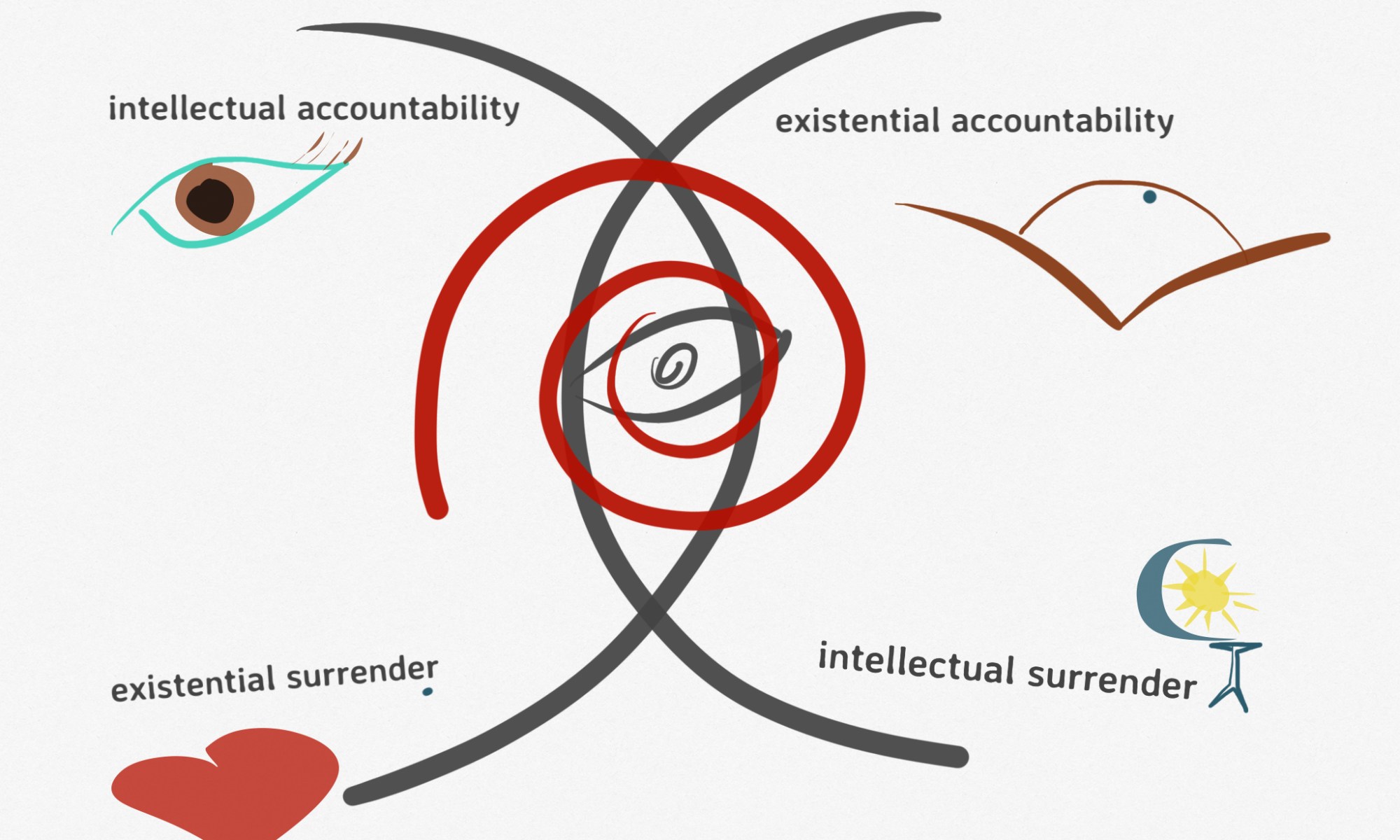
Utilizando imagens e metáforas para contestar a escrita convencional acadêmica, esse artigo levanta questões relacionadas aos desafios de imaginar e existir na beirada-limite dos paradigmas vigentes. O artigo propõe uma reflexão sobre a relação que estabelecemos com o conhecimento no contexto da modernidade através de economias intelectuais, afetivas e materiais que estão entrando em crise. Nessa reflexão, leitores e leitoras são convidados/as a imaginar os trabalhos e as responsabilidades intelectuais e existenciais envolvidos no processo educativo de transição pelo qual estamos passando no mundo inteiro. Esse processo educativo consiste na administração de tratamento paliativo no declínio de um sistema insustentável, e no prestar assistência em “partos” de possibilidades inéditas que possam valer-se das lições aprendidas com os erros recorrentes do passado, para que somente erros novos sejam cometidos no futuro.
PDF: educação para a expansão de horizontes, saberes, vivências, afetos e possibilidades de (co)existência
 Gesturing Towards Decolonial Futures