affective dispositions of engagement

These dispositions manifest in complex and unpredictable ways, at different points in time, depending on contextual factors. Being able to identify the disposition(s) we bring to a specific conversation and its implications can open different possibilities of engagement.

Screen Shot 2018-02-13 at 18.40.45

Skattebol conceptualises affect as a capacity and as a “tangible, embodied force that operates between people” (78). She claims that affect is different from emotion as “it operates at a physiological level, that is – beyond consciousness” (ibid). Skattebol emphasises the patterned nature of affect that happens via repeated (and socially-historically situated) collective mediations that converge in individual affective biographies (Skattebol, 2009; Nathanson, 1992). She argues that:


…[a]ffect is organised at an intra-subjective level of the body but also organises intersubjective exchanges. Affects are generative and contagious; they are innate activators themselves, for example, shame can produce a blush – the red heat that in turn produces more shame. […] Differentiated affects operate as feedback to the self and play a major role in the meaning made of experience. Furthermore when people transmit affects – fear, distress, anger, shame and so on – the affective force is unruly and unpredictable because other people’s affective responses and patterns transform the original affect.[…] Affective patterns become habituated through life experiences but can also change through new inter-subjective experiences. (78)

We are collaboratively developing performative embodied exercises that can help us become more intimately familiar with the architectures of affect that pierce through our bodies. More soon!

Skattebol, J. (2010). Affect: a tool to support pedagogical change. Discourse: Studies in the Cultural Politics of Education, 31(1):75 — 91

Po-ethic inquiry #3: a song of quetzal

There is an ancient prophecy

shared by people of the color of the earth

in different corners of a ripe land

that eagle and condor will soar together in the same sky again

after five hundred years of separation


The blue and starry vault will rejoice with this encounter

And clouds will tear up in tears of joy

Greening the desert

And water will run freely in her beds

Making of her flow a tender caress for the earth

Eagle and condor will share lessons

Of healing, remembering and awakening

Sensing their visceral connection

and dismantling the nightmare of a fractured sky


but condor and eagle are not alone in the winds

the long mantle of feathers of the quetzal

must also kiss the clouds and celebrate the forest

to facilitate this sacred encounter


for the quetzal is in a space of indeterminacy

and cannot be placed in the North or in the South

the quetzal embraces what is ch’ixi

mottled, baroque, strikingly colored,

for she is one with the rainbow

and the rainbow is a reminder of difference in harmony

every color together without melting

or assimilating

or being included

just being

shining with the others

The condor, the quetzal, and the eagle

Dance in the skies the symphony of four hundred feathers

Beating to the sound of stars

Their pedagogy is based on learning to listen

The song that heals

A song composed of many songs,

and none

Because listening truly is to cultivate the capacity

To have the heart open

To sense the truth of turning the heart into a verb

And allow for the medicine that vibrates

To heal our dismemberment

And be able to glimpse the rainbow in the middle of the forest

While walking with a gatoperro

Expand our imagination and sensibilities

To touch a We composed by neither me nor you

Vulnerability brings strength and with this strength

We’ll be able to defeat the isolation of the pain and fear

Let us pause for a second

see the flight of a feathered serpent

and wonder

can we learn to become related again?

Po-ethic inquiry #2: dragons…

Once upon a time there was a very special land, very different from the ones we know today.  That land knew how to speak in the language of the dragons and taught the dragons’ language to its people. So the people who were born or called to live there knew that they were related to the dragons.  The dragons themselves were very curious beings. They could be visible or invisible. Big or small. They could be flat or round. They could shapeshift into any form they wanted. Today people usually draw them like this:

Screen Shot 2018-02-09 at 13.54.44

But dragons were not necessarily anything like that. In fact many of them would be very much surprised, if they saw that people can only imagine them in one single form and shape, rather than in all the others that they could take. Today, very few people can imagine dragons differently and because of that most of us would never recognize one, even if the dragon would be starring at us straight in the eye, right above our noses. Actually… that is what happens more often than we would know. There are still plenty of dragons around, but it is very rare that people can sense or recognize them.

Many, many years ago, before the single image of the dragon that most of us share today took over people’s minds, people knew that even if they perhaps couldn’t always see the dragons, they could feel their presence. Well… most of them could. And some could feel it more than others. While everybody knew that when the winds were very strong and howling, the dragons were very active in the sky, only some people could see the signs of the dragons’ activities in the tiniest of things. Like in sudden surges of heat, or peculiar shapes of the clouds, the particular way the moon would reflect in the water, the changes in the brightness of the constellations in the sky, the quiet whispers of the trees or in the colors and the dances of the small lizards. Some people were so sensitive that they could even talk to the dragons. And sometimes the dragons even talked back. They would share gifts and favors.

At that time stories were also magic creatures. They were not what we think of them today. No, no, no… They would grow in the land, enter your body through your toes touching the earth, jump up and down in your stomach, squeeze your lungs, tickle your throat and come out of your mouth like a swarm of rainbow butterflies, or a flood of murky water, or an icy avalanche, or an army of mushrooms. Stories would play between humans and dragons and weave the fabric of connections between the seen and the unseen worlds. Things were all right back then.

But the dragons knew that there were two storms coming in the distance. One from the North and one from the West. During the first storm people would start to capture the stories and trap them in books and the stories could not play anymore. The captured stories would be prevented from weaving the fabric between the seen and the unseen worlds. Powerful men would begin to see the unseen world as a threat. Some women would protest and try to keep the relationships alive. They were punished very harshly for that.

The dragons became very worried. They wanted to help, but the imprisoned stories couldn’t weave the connections anymore. People started to believe only in the things that they could touch and see and that were written and jailed in books. They started to mistrust one another and built castles to protect themselves from each other. One of these castles was built on top of a house of a beautiful dragon. The owner of the castle wanted to cut off his head by proposing to lure the dragon to the castle and release the main grate on his neck. He even jailed a story about it in a book, but he could never really have done it. The dragon heard about the jailed story and asked himself: What the heck are these people doing? As people became more and more distanced from the dragons, the dragons also distanced themselves, because they could not understand why the people had lost their ability to be kind.

When the second storm arrived, people started to shrink and jail their hearts in thick boxes made of mirrors and their shrunken hearts would now only be fed with the value of money. Because such inadequate food never filled them up, they started to transform everything into money: the animals, the plants, the rivers, the mountains, anything that they could see and touch. They fought wars over who could put the most money in their mirror box. They were about to destroy everything. The dragons could not believe what these people were doing. Sensitive people were still being born, but they lacked the language to talk to the dragons. They even searched for the dragons, but their senses were partially numbed. They also did not know what to do. The dragons however had an idea…

They knew that on the other side of the Earth there were powerful turtles who had ancient wisdom. They decided to ask the turtles for help. At that time turtles themselves were facing similar problems in their part of the world too. The turtles and the dragons decided to put the sensitive people together. They plotted how they would travel to each other. The dragons and turtles left several clues to be found by the people, such as maps, images, songs and dances…. For instance, one of the messages from the dragons was delivered to a sweat lodge in Turtle Island. And one of the people there was asked to come and visit the dragon relatives to remind them of their responsibilities. The dragons and the turtles figured out that they needed to work together so that people could also work together. And they needed to contact all the other invisible beings around the Earth to join their effort too.

They wanted to release peoples’ hearts out of their mirror boxes and to revert back the things and beings that were transformed into money. They also wanted to liberate the jailed stories from the books so that people could begin to trust each other again. That was the plan. To send people powerful messages that could not be jailed in books, at the same time, to remind them of the wider families they belong to and that they were much more than what they had become. So all creatures – seen and unseen decided to join in to help the human people. The plants in particular gathered powerful medicine in specific leaves and barks of trees and whoever would eat them would have access to the the unseen world. The water and the dolphins composed a special song that – for those who could hear it, would make their hearts break out of the mirror boxes and expand and connect again. The moon and the sun created new nuances of color and light that would revert back the spell of the money and they also whispered for all babies that were born a spell that could free the jailed stories.

As the storms subsided, people learned a lot about their greed, their arrogance, their vanity and they realized that they were the youngest beings and that they behavior had been very foolishly and immature. By learning about their mistakes they grow up a little, so that in the future they would be able to make different kinds of mistakes. The dragons, the turtles and all the other being were exhausted after this long struggle and they needed some rest, but they went to sleep with one eye open, so that they could watch for the next mischief of their younger relatives. What can one do… a dragon’s work is never done…

night.png


boxes

there was a time when
i was born as a human
a wombed, brown skinned one
in a criss-cross of different dna
of human bloodlines in conflict
in a period of turmoil

in that period
in an act of rebellion
against time and death
humans had become
obsessed with meaning
as a way to index
and to control reality

like, dividing the world into pieces
and putting these pieces in boxes

the boxes were then organized
hierarchically
in imposed orders of importance
that reflected their worth and achievement

the main boxed idea
was that all human relations
should happen through the boxes

they believed the right box-belief
could explain, describe, define, prescribe, fix
and tell us exactly who we are

boxes would allow everyone
to touch, to own and to contain
real truth, justice and beauty
once and for all

the boxes worked like
“boxhouses”
“boxborders”
“boxdisciplines”

they justified expropriation
in the name of progress and development
they justified theft and murder
in the name of law and order
they justified rankings of the value of life
in the name of “civilization”

in this period
humans understood wealth
as the decorations of the boxhouse
they started to fail to notice
that the walls that they had built
to protect the accumulated junk
trapped them in the abject poverty
of the emptiness of existence
in boxed separation

humans forgot
how to experience the world
how to dream and to hope
beyond the walls of their houses and borders

it worked like a spell
that scaled up their boxheads
shrank their bodies
and numbed all senses
that refused to comply
or fit into sense-making

eventually the boxhouses
resembled prisons
in a lockdown
of saturated expired meaning

although boxheads and boxhouses
were cluttered with cheap junk
they felt empty

at first people felt bored
then sad…
then cheated and angry…

they started wars
over meaning and choice
over boxhouses (in the name of property)
over boxborders  (in the name of sovereignty)
over the superiority and righteousness
of their boxheads (in the name of pride)

they fought and killed
for their perceived entitlement
for “boxsecurity”,  “boxstability”, “boxnormality”
and the cracks and damage
were fixed with weaponized cement

the story of patching the boxhouse
from the inside
went on for the longest time
and repeated itself time and time again
until something happened

a fungus arrived and spread from each corner
of anything box-related
it compromised the structural stability
of anything box-like

all boxes collapsed

and every animal of the human species
could breathe unboxed air again.


A/r/t/cart/ography #3: the beach

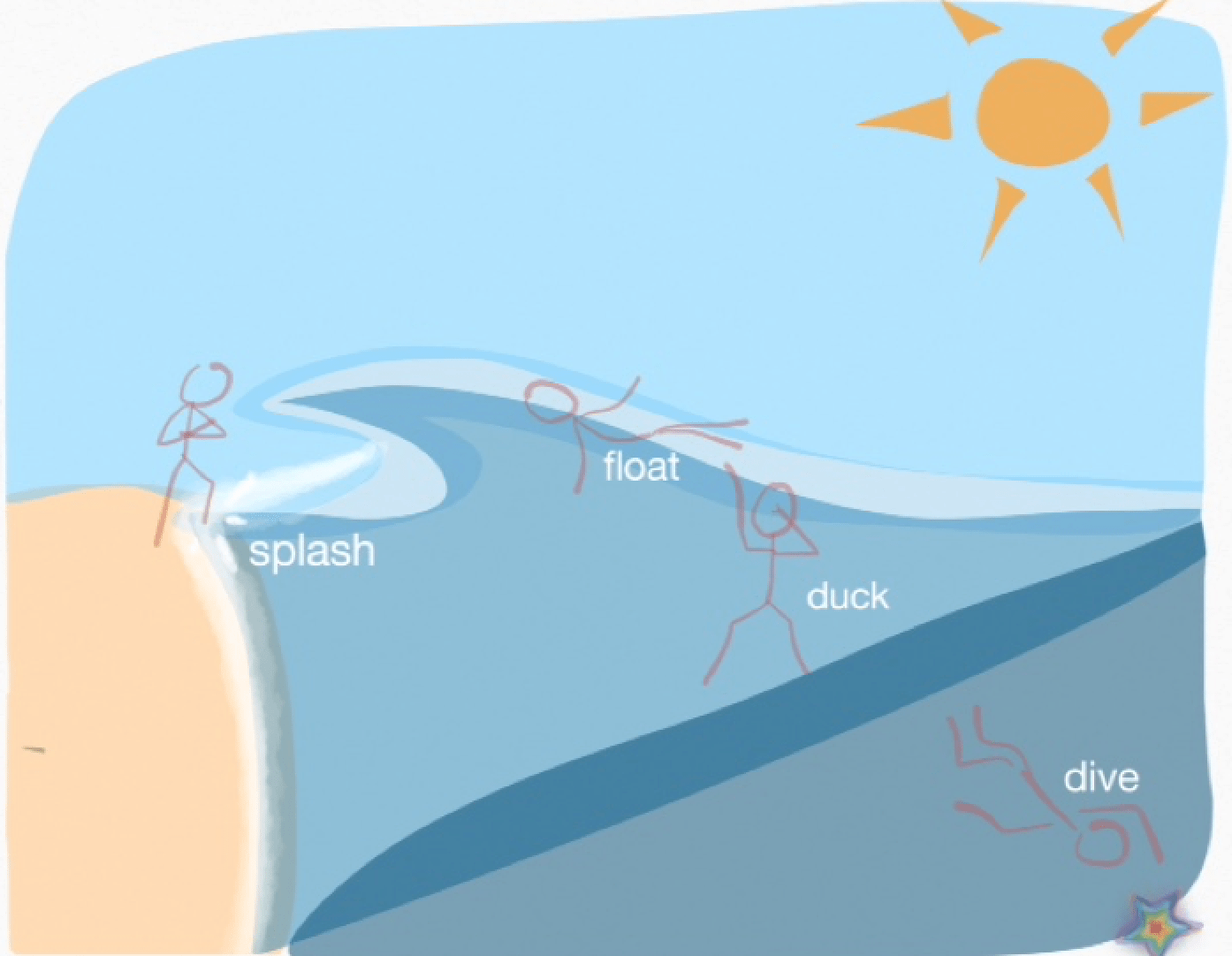
“The beach” has been used in our collective as a cartography that attempts to articulate different affective investments that people bring to engagements with global challenges and global justice. It emerged as a response to the need to talk about our fears of “drowning” as we face the complexities, complicities, paradoxes, uncertainties, inequalities and contradictions of social and global justice work.

Screen Shot 2018-02-08 at 17.19.24

The “splashing” position is one where people are just testing the waters in relation to a specific issue – they need basic information and are motivated by whether or not they feel comfortable and confident to have a positive experience in facing the breaking waves of a particular beach. In global justice education, people in this position would be asking informational questions like: What is the problem? What is the way forward? How does it affect me? Why should I do something? How can I start to contribute to make it better?

The floating position evokes aspirations for a comfortable spot beyond the breaking point of the waves, where one is in control of a situation and can relax. This position is where people seek tested models and solutions that can be systematically implemented to deliver pre-determined results that can be effectively measured. The general idea is that a correct, unambiguous and authoritative definition of an issue will provide the clarity for solutions to be found and policies to be made. These solutions and policies will then be interpreted and implemented in a seamless way, producing the desired outcomes determined from the outset. Most funding mechanisms operate under the premise that this is both possible and desirable, which is counter-productive as it restricts analyses and horizons of intervention and encourages cosmetic narratives of effectiveness and success, which prevent people from admitting to and/or learning from failure. Questions in this position tend to be methodological (related to ways of doing):

What strategies are effective? What outcomes are expected? How can outcomes be objectively measured? How does/will it work? How to improve effectiveness? What obstacles prevent success? What knowledge/expertise/data/ is missing? What policy is needed or not being implemented correctly? How does this compare to what happens in other contexts?

The ducking position is where people start to put their head under the water and open their eyes to realities that significantly challenge what they had expected (or wished) to see. In this position, there is a tangible fear of drowning in the murkiness of complexities, complicities, ambivalences, paradoxes, inequalities and uncertainties of an unfamiliar “larger picture”. As we learn to develop the capacity to spend more time under the water, we also have to use floating techniques to come to the surface to breathe. Questions in this position tend to be epistemological (related to ways of knowing):

Who decides which direction forward is? In whose name? For whose benefit? How come (i.e. historical/systemic forces)? How are dissenting voices included (or not)? Who would disagree with our solutions? Whose terms of dialogue/inclusion are in operation? What collective traumas are present? Why? Who has been historically and systemically wounded? Whose vulnerabilities are visible/invisible? What notions of authority, merit, credibility, normality and entitlement are at work? What is being opposed and proposed as replacement? How am I complicit in harm? How am I part of the problem? How am I reading and being read? How can I enact ethical solidarity? What truths are we not ready, willing, or able to speak or to hear? What assumptions are we taking for granted? If there is no one right answer but absolute relativism is not the answer either, then how can we learn to practice discernment and contextual choices? How can we work across difference/collaborate without requiring consensus?In what circumstances is theorizing relevant/useful/helpful and in what circumstances does it get in the way?

Moving from ducking to diving the questions tend to focus on the depth of acknowledged and unacknowledged affective investments and foreclosures or sanctioned ignorances (related to ways of feeling and relating):

What are we deeply attached to? Why? What do we get out of it? What social tensions are we failing to recognize? What cultural ignorances are we continuing to embody? How can we remain accountable for our ignorances while recognizing that we will not be able to address them all at once, or possibly ever? How can we work within imperfect or even violent systems and institutions in meaningful ways, while knowing that we may be contributing to harm? What important questions are we not asking? What fantasies/delusions are we invested in? What are our perceived entitlements? Where do they come from? How do they get in the way? What prevents us from listening deeply without fear and without projections? Do we know how to listen? Where are we stuck? What is keeping us there? What do we need to give up/let go to go deeper? How can we distinguish between distractions and important stuff? How are we being accountable to future generations? What do we need in order to uphold our individual and collective wellness as we continue?Are we still being driven by the desire to ‘get it right’, and if so, how can we interrupt this desire and what else might drive us?If we are not driven by the need for immediate answers, but don’t want to spend our time on efforts that will lead to neither healing nor learning, how do we decide what is worthwhile? How should we respond to/defend ourselves from violence? Is it possible for our modes of self-defense to break the cycle of violence, or is that asking too much? What can trigger us into unproductive defensive states? What insecurities do these states expose or try to hide? What are our fragilities? Whose bodies are carrying the weight of the emotional labour necessary for our learning?

As people develop the stamina, breathing capacity, visual ability and diving techniques to spend more time under the water, they start to ask ontological questions (related to ways of being), such as:

Who are we beyond our perceptions, self-images and categories of thought? How can we presence the world without identifying or dis-identifying with it? How can we disarm and de-center in order to be able to “be with” where we are and what is in front of us? If what matters is what still matters when we are no longer in these bodies, how do we recognize and honor that? How can we be naked and vulnerable before each other without fear? How can we respect the pace and readiness of people’s learning while being accountable to the individuals and communities negatively affected by this learning and its pace? Who is bearing the costs of my learning and its pace? What are the non-human ‘people’ around us teaching/showing/reflecting back? What and how are our ancestors (those who have come before and will come after us) communicating with us? How can we support each other when we fail or make mistakes? How can humour, art, eros, tricksters, the non-human and the divine be welcome and respected as important teachers? How do we un-numb? How do we awaken other senses? How do we reason beyond time and form (organic temporalities)? How do we make space for the land to imagine/dream/design through us? What can we learn from the failures, limitations and successes of this experiment? How can we stop this new learning from solidifying into a dogma? How can this learning be passed on to others so that mistakes may not be repeated? “Who is this really about?”

The article “The educational challenges of imagining the world differently” (Andreotti 2016) presents a more detailed analysis of why these questions are important in educational work. Further ideas on how these questions relate to global justice can be found in the books “Ambiguities of Activism: Alter-Globalism and the Imperatives of Speed” (Hoofd 2012) and “Against Purity: Living Ethically in Compromised Times” (Shotwell 2016).


  • Andreotti, V. (2016). The educational challenges of imagining the world differently. Canadian Journal of Development Studies/Revue canadienne d’études du développement, 37(1), 101-112.
  • Hoofd, I. M. (2012). Ambiguities of activism: Alter-globalism and the imperatives of speed. New York: Routledge.
  • Shotwell, A. (2016). Against purity: Living ethically in compromised times. Minnesota: University of Minnesota Press.


Po-ethic inquiry #5: brutal kindness

We welcome you to our country
Our borders open only to a few
We ask for nothing in return, except
That you recognize the deepest wisdom
That when in Rome you should pay tribute to the Romans

Therefore, you must
speak our language
admire our deeds
adopt our dreams
obey our laws
embrace our values
praise our intelligence
like our food
fulfil our expectations
mimic our behaviour
contribute to our economy
aspire to be like us
commit to serving this country
dedicate your life to our people
and be thankful for our efforts to help you

We offer you unlimited hospitality
We chose you amongst countless others
We ask for nothing in return, except
That you acknowledge the natural exceptionality of our people
Expressed precisely in your inclusion in our society

Therefore, you must
know your place
do as you are told
strive for your best
work twice as hard
feel indebted
show good manners
be clean and organized
get an education
dress appropriately, smell nice
pay your duties
lay low, be happy, focus on positive things
use language that we can understand
entertain us with your culture, when requested
and jump off the balcony, if required

We give you access to the best welfare and education system
We expect you to show us that you truly deserved it
We ask you for nothing in return, except
That you appreciate the privilege of being allowed amongst us

Therefore, under no circumstance,
should you break our trust
complain or communicate disapproval
expose our inadequacies, reveal our contradictions
disclose our insecurities, question our values
challenge our authority or understanding of reality
make up unreasonable accusations
fuel internal dissent
defy our right to distinguish our heroes
remind us of what we choose to deny
speak of the past we want to forget
outperform, outsmart , outshine us
or bite the hands that feed you

We will do everything in our power for you to properly fit in
We are certain you will acknowledge our benevolence
We expect nothing in return, except
Your gratitude and compliance

Therefore, you will not mind when we lovingly
limit your autonomy
mute your conscience
undercut your confidence
interrupt your dreams
place your body and mind under surveillance
and shape your subjectivity into conformity
for your own good

We will give you incredible opportunities
in an incomparable country
We ask for nothing in return, except
…that you salute our openness, altruism and sense of justice

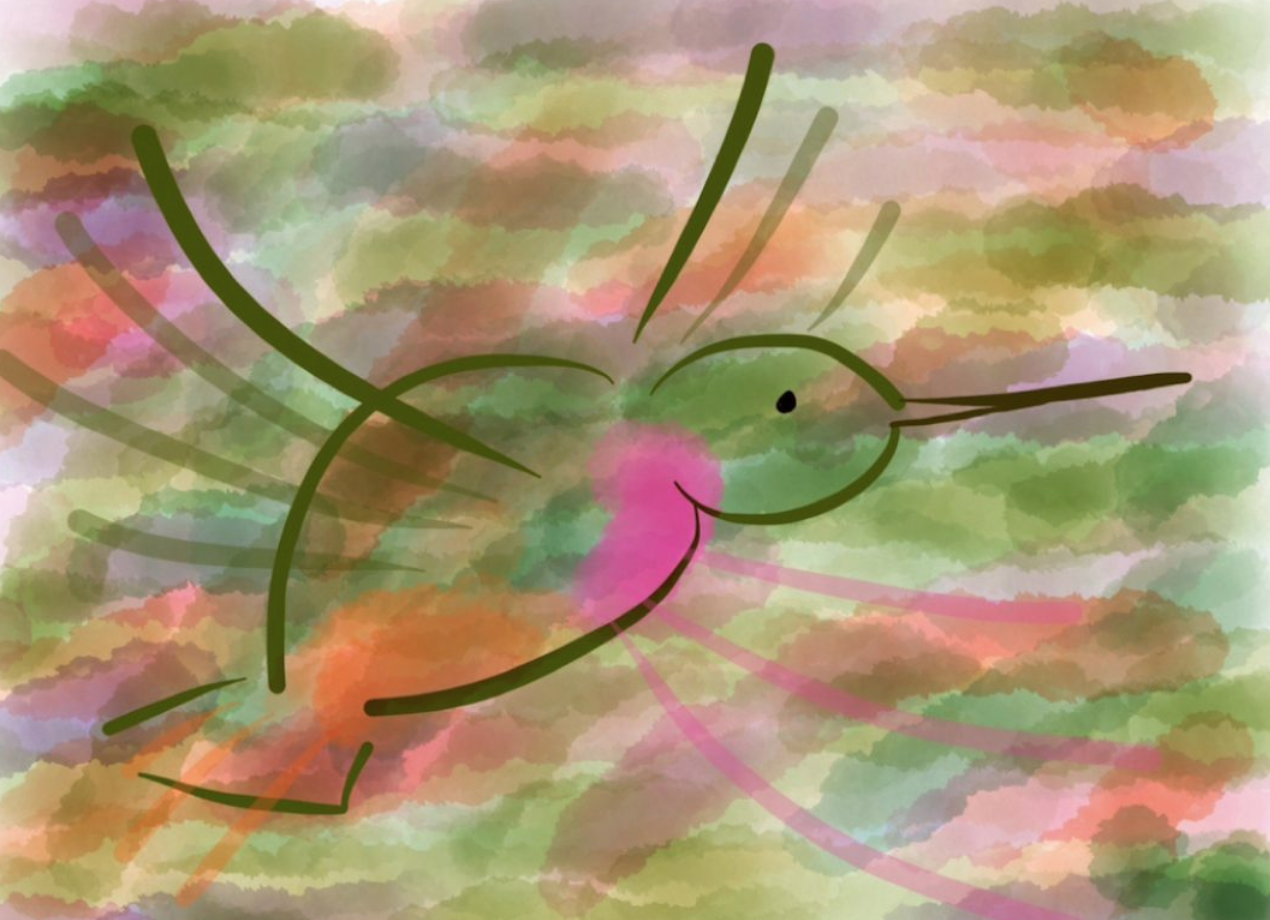
Text: hummingbird

This text is an adapted transcript of a keynote presented at the Indigenous Scholars Conference: Indigenous Epistemologies: Re-Visioning Reconciliation on 26 March 2015, at the University of Alberta. It has been accepted for publication in the Canadian Journal of Native Studies.

I am from a family with Indigenous Latin American and German ancestry. I have been to many different countries and lived in different places. I believe this is partly because the Indigenous tradition my family comes from is nomadic. They see the earth as a living entity, and if they stay in one place they believe the land gets sick. They travel to where their ancestors send them, and this and other important messages are conveyed through their dreams. I married into a Cree and Blackfoot family where ceremonies are performed with the Blackfoot in Alberta. My son also married into a Maori whanau (family) in Aotearoa, New Zealand.

This inter-weaving of bloodlines gives me a perspective of many different Indigenous communities. I am no expert in any of them, and I do not speak for any of them. I also find it difficult to pinpoint only one place where I “come from.” In part, this is because I believe that the earth is alive and upset about fences and divisions. It is also because the tradition of being always on the road, crossing many different types of borders means one has to feel the pathway itself as a place too: one that enables you to see different patterns, different connections, as well as many similarities, and that offers a different kind of contribution to the whole. From this place, I would like to offer a story that speaks to the crossroads and the in-betweens.

I was coming out of a meeting at the University of British Columbia (UBC), where I work, and I found on the floor a dead hummingbird; it looked like it had died recently. At first I did not know what to do as I did not want people to step on the tiny bird. I could not leave it there, so I decided to wrap the dead body of the hummingbird in my scarf. I sang it a couple of songs, and put it in my bag because I was going to a lunch meeting and could not go straight home. I went to the meeting, had lunch, and really forgot about the hummingbird.

If we cannot see the hummingbird, it is because we are sleeping. People who were oblivious to the hummingbird, seemed to be so much in their heads, in their minds, that they could not really notice him: they were in torpor. I spend part of my life in torpor too.

As I was leaving the restaurant, I remembered the hummingbird and decided to show it to a friend. I took my scarf out of the bag and exposed the body of the hummingbird. As we were looking at it, to my greatest surprise, the hummingbird started to flex one of its legs. At this point the hummingbird’s heart began to race, and I thought that if I did not do the right thing, I would end up killing it. I decided to go straight to my office.

The hummingbird was slowly awakening and started flexing his wings, but his feet seemed to be entangled in my scarf. I took him outside in the scarf, but he would not fly. I thought: I’d better take him back to the tree where I found him, and then maybe he will know what to do. I started walking on campus; to get to the tree, I had to go counter-current through a lane full of people. It was a busy time when students had just finished their afternoon classes. I was carrying a scarf with a hummingbird flexing his wings, as if he was hovering on top of it. I had a miracle in my hands, going through that crowd. What really broke my heart is that nobody looked at the hummingbird. Nobody saw it. As I approached the tree the hummingbird flew away. And that was the end of my encounter with the hummingbird.

I went back to my office, and I started to research where those UBC hummingbirds come from. They come from Mexico. I also found information about the state that the hummingbird was in when I found it. When hummingbirds find an external threat, they go into a state of sleep where just eight percent of the bird’s metabolism keeps it going. This state is called torpor. In this state, they look dead. They take about an hour to “wake up” when the threat has been overcome. Maybe being in my bag protected by the scarf just gave him the warmth to come back to life again.

As I told the story to my Cree partner, he asked me to pay attention to what the hummingbird came to teach me. Reflecting on the hummingbird’s teachings took me back to the people walking without the ability to notice the hummingbird flexing his wings on top of my scarf. I believe the hummingbird was trying to teach me about torpor — the state of torpor of the people, who could not see him, as well as my own torpor. If we cannot see the hummingbird, it is because we are sleeping. People who were oblivious to the hummingbird, seemed to be so much in their heads, in their minds, that they could not really notice him: they were in torpor. I spend part of my life in torpor too.

From that point on, I started to think about an education that can awaken us all from torpor. I also started to think about this state of torpor in relation to what we are protecting ourselves against: what has created the state of torpor. If there is a threat that is prompting us to fall asleep, if we do not understand or face this threat, it is going to be extremely difficult to wake up from that state. And if we do not see the implications of being asleep, we might not want to be awakened, because we may be afraid of being awake. I imagined all these people coming to me with huge sleepy heads and very little bodies–heads that scale up our sense of importance, our sense of entitlement, our sense of control of everything, our sense that we are in a bubble that separates us from each other and protects us from the world. It is this sense of separation that presents the world as a threat, as something we need to be protected against and this creates a form of existential poverty.

Existential poverty is a denial of relationship (Donald, 2012), a denial of entanglement, a denial that our lives (both human and non-human) are all inter-woven. This denial leads to torpor and to the fear of awakening. Existential poverty also leads to material poverty because by trying to protect ourselves from each other, we start to accumulate stuff as walls between ourselves. We think that “stuff” is going to give us the affirmation of individuality and security that we believe we are entitled to.

I started to think about what has been scaled down so that the head could be scaled up. What has been scaled down for me is our sense of visceral connection with each other. We have been told that thinking is everything; that “we are” because “we think”; that reality is only what fits our enlarged bubble thinking heads. We have been taught to think about ourselves as much smaller and more limited than we actually are. I started to wonder about an education that could scale up what has been scaled down, that could un-numb the sense of visceral connection, and the responsibility that this entails. But also, the idea that we can scale up and connect the unique healing medicines located in our (different) bodies so this combination of medicines can contain and heal our collective pain, all the pain we have inflicted on each other.

We tend to think about hearts as limited, and to be afraid of the pain that we are going to face in the world because we may feel that our hearts are not strong enough to take it in. But as I was thinking about the teachings of the elders that have been in my path — and I have had the privilege of having elders in different traditions — I realized a common pattern. They have taught me through different stories and by example that we can scale up and connect our hearts. The same way that we can scale our hearing, so we can focus our hearing on something that is near or something that is far in our sight, we can make our hearts smaller, or bigger, enormous. Our sense of identity can also be perceived in the same way. We can be just this body, this ego, a defined identity, or we can be unbound spirit, we can be part of everything. Our sense of land could be just our home, our reserve, our country, or it can be the whole earth, or the whole universe.

Part of the problem with the kind of education we receive at university and schools is that we forget how to scale up the important things. And we scale down things like generosity, compassion, humility, in order to be able to participate in a system that has given us a few gifts, but that depends on violence to be maintained. So here I draw on Cash Ahenakew’s  (2014) work to talk about this paradox that we face as Indigenous people all over the world. This paradox has two sides. On the one hand, there is the necessity to survive in a modern capitalist context that is inherently violent and completely unsustainable, a system that makes life outside of it almost impossible, unless we are “off the grid.” We have to fight for our lands, our rights, our languages and our cultures using the language of the nation state, if we want to be successful.

On the other hand, and at the same time, if we know that system is unsustainable, we have a responsibility to give our children an alternative mode of existence that might not be defined by that system. So how do we do the two things together, knowing that the first system tends to define our existence very quickly? Do we as Indigenous and non-Indigenous educators, as people who are here to support young people, just support them to get through the system and then they become one of the people who came towards me and could not see the hummingbird? Or do we just socialize them in traditions where the hummingbird is one of the most important things to be seen? Can we train them to be successful in the existing system and to be awake, to be able to see the hummingbird? If they are awake and within the colonial system, will they be able to survive the pain without knowing how to connect and expand their medicines and hearts?

I believe these are discussions that we need to have. We have been thinking about an education for walking both worlds, but we have not yet really talked enough about the difficulties and the complexities of doing that, in the sense that young people feel torn, or sometimes fall through the cracks of both worlds (Battiste, 2000). Perhaps one way to think about it is through the concepts of material and existential poverty, and material and existential wealth. We need to think about the ways that material wealth, which has been associated with affluence, competition, and individualism, has caused a lot of existential poverty. So, how do we pass a notion of existential and material wealth to our children that upholds the dignity and wellbeing of every being, both human, more than human, and non-human, a notion of wealth that does not harm other people or the planet and that honors ancestors as people who have come before and of people who are yet to come?

This is the kind of education that I have been thinking about in terms of working at a university that, after this experience with the hummingbird, feels very much like an ivory slum, in terms of the existential poverty it promotes. Within this context, I also wonder about what reconciliation means and what it looks like. When I get really frustrated, part of me starts thinking about exiting: I just want to get out of institutions, return to community, forget about the university. Another part of me remembers that the process of reconciliation requires us to be where the problems are. I am not talking just about the reconciliation related to the effects of colonial violence, but about the (difficult) sense of wholeness and oneness that we have to have if we want to open the possibility for another form of existence in this planet. It is a reconciliation that starts in our guts and stretches out to recognize our inseparability. In many ways, being in the ivory slum is extremely important. And it is also really hard. And it is very difficult to face that existential poverty and not know what to do.

I find courage when I manage to de-center and to trust that there is an ancestral vision guiding where I go, a vision that knows why I was sent to this place, even if I do not know. That is what I try to say to myself in moments of extreme frustration. This helps me remember that the process of turning towards existential wealth involves dealing with the existential poverty that we see around us and within us. And that the “us and them” mentality works for certain things to a certain extent, but ultimately does not really speak to that yearning that we have inside of us, which is a yearning for wholeness, for wellbeing, for connection. This can only be achieved when we are together.

As an Indigenous scholar from Trinidad, Jacqui Alexander (2005) has pointed out that we confuse this yearning for wholeness with a yearning to belong, or a yearning for identity, for individuation, or for affirmation. And that, again, works in certain contexts and has saved many lives. I am not dismissing that. But maybe that yearning will only be addressed in the long term, not necessarily through more thinking or more dialogue, but through a renewal of our relationships, and our awakening to this visceral sense that we are individually insufficient and collectively indispensable. Regardless of what has happened in the past, if we use the same frames of being that create violence to resist violence, we will reproduce more violence. If focusing on thinking alone, on “making sense,” is not the answer, what else can we scale up so that we can remember to listen and relate to every being, not necessarily through conceptual language, but through our bodies and our spirits? How can we remember how to “sense sense,” to access other forms of reasoning, without dismissing the gifts of the rationality that we are over-socialized into?

I believe this is what the hummingbird came to teach me that day. I am glad that I did not kill it accidentally by forgetting it in my bag. I am really glad that we both came back alive. The ideas of torpor and of the university as an ivory slum have been very helpful, both in terms of understanding what my role is in that space, and in understanding how my own frustration reflects the same existential poverty that I am trying to address.

Seeing the frustration itself as a trickster teacher, showing me that my ego also reproduces and has been trained in that same kind of thinking, has been very useful. Being able to let go and allow this other vision to come in is very difficult, especially when you have to keep your webpage updated saying how great you are at competing with others: how much research you do, how much knowledge you have, how many articles you have written, how much money and how many awards you have received. I look at it and feel my stomach turn. But I trust there is something beyond myself that moves us where we need to be. It points to the life force within every single one of us, even when we do not want to listen. I believe it sings us a song that speaks of being awake, of breathing, of knowledge coming in dreams, of being undone, of healing and dancing precisely because of the scars we carry. It invites us to a natural state of vulnerability where obsessions with the meaning of an individual lifetime loses centrality as we see the same matter (or flesh), animated by a life-force that precedes it, as constantly morphing into different forms and different learning experiments. In this sense, awakening requires an interruption of our satisfaction with torpor and the false security we have with the illusions of individuality and of control that come with it. Once we let go of that arrogance, we can un-numb our senses and renew our relationships, by noticing that we are, simultaneously, one, many and the creative potential of ‘nothing’, as we inhabit bodies/flesh/form in linear time/reified space – and not – all at the same time.

On the other hand, I do recognize that I cannot be in that state all the time, and that there is anger, trauma and childishness within me. And these forms that I take, take me to enclosures of thinking and to a sense of entitlement absolutely grounded in the “us and them” separation, which depends on a denial of my entanglement with everything else. Maybe these entities are also part of entanglement. In this case, the question is how can I encounter these forms of my self productively without being overcome by their narcissistic tendencies? How can I identify and name the colonizers who appear as external to me (obviously I have to do that sometimes) without allowing that definition to determine my relationship with those people, and without seeing myself in them? When should we play the political game, in the pre-defined political context, and when should we breach those definitions and insist on other forms of relationality? Can we do both at the same time? When should we center ourselves for the benefit of our specific communities and when do we de- center to allow the land to imagine through us, for the benefit of all life forms (Longboat & Sheridan, 2006)? If this is not a matter of ‘either/or’ but ‘both/and more’, as my brother Hemi says, how can we mobilize both strategies without having the one least practiced subsumed by the other, which currently colonizes both our hopes and our imagination, giving us safety in a state of torpor?

I must acknowledge the elders who have taught me the most about this. These elders are Keith and Karen Chief Moon and Leroy English who are Blood elders from the Kainai reserve where I sundance. Above all, they show me that humility, generosity and compassion are not intellectual choices, not attitudes you decide to have, but waves that are radiated through you, when you tune to a different wavelength of being. Keith’s story is a beautiful story. For the past six years I have witnessed the process of him sustaining a Sun Dance created from a vision he had forty years ago: of people from the four directions dancing together to reconcile on the land’s terms. According to the vision he received, people would arrive at his Sun Dance, and he would not be able to send them away because it is not the bodies that would arrive – it would be people’s spirits asking to dance. I have witnessed people from other Sun Dances coming and telling him that what he is doing is wrong, because people in the dominant culture are used to appropriating Indigenous knowledge and using it in bad ways. I have heard people saying, “White people will come here, and in five minutes they are going to be bossing Indigenous people around thinking they already understand everything.” And it is true; they are trained to do that.

However, Keith’s response has been really interesting and has taught me something that I did not expect. His response is always that he agrees, on political grounds with the criticisms, but that the land is a sacred place, that his vision is also sacred and that this vision does not require consensus. What he has taught me is that spirituality trumps politics. Seeing him respond with generosity and with compassion to people who act arrogantly or stubbornly due to their torpor or training has helped me to identify and not be afraid to learn from my own arrogance. Keith has established a distinction between necessary political relations that require political agreements and frontiers, and existential relations grounded on visceral connections and wholeness that create a wavelength where frontiers do not exist, a wavelength where all our 99 senses point to the fact that we are each other.

At that Sun Dance I learned there are two groups of elders (who come in many ages): those who insist they know (which is a sign that they don’t), and those who insist they don’t know (who could be on to something). Both are important. Elders in the first group see education as the distribution of answers to be consumed or wrestled with. Elders in the second group see education as a recalibration of a search beyond meaning and the individuated self – a search driven by doubt that often gets stuck in distractions when certainties creep in. The first education gives us languages, concepts and ideas to play and experiment with. The second education demands that we loosen the grip when these things get confused for the path itself, when they become the cement of our ontological securities, getting us entrapped and immobilized precisely by giving us the impression that we are moving somewhere. Combining both types of education requires patience, humor, self-compassion, vulnerability, discernment, and, above all, a healthy skepticism towards one’s own and other knowledges and desires.

Perhaps torpor could be considered as a consequence of the overdoing of the first type of education. When knowledge becomes an instrument of existential arrest we get stuck in distractions. Awakening from torpor does not mean dismissing or banishing knowledge, rationality or identity, but recognizing unhealthy attachments and investments in these things that foreclose on our capacities for a multitude of other possibilities for sensing, reasoning, relating and being. In times of exhaustion or scarcity, hummingbirds shut down their metabolic system. Under conditions of perceived existential scarcity, we may likewise shutdown our capacities, and forget that they exist as we embrace the illusions of safety in our sleep. Perhaps the second education can help us to learn to let go of the strong faith we have on detractions. This may, in turn, loosen the grip that they exert over us, allowing the search to unfold otherwise, awakening our capacities to fly again.

senses
of resonance
of awe
of fusion
of possibility
of form
of being
-in-breathing
-in-beauty
-in-flux
-in-vulnerability
-in-time/space
of embracing
the miracle,
the privilege
the responsibility
of being alive:
both one, many
and nothing,
entangled
unfinished
and free


References
Ahenakew, C., Andreotti, V., Cooper, G., & Hireme, H. “Beyond Epistemic Provincialism: De-provincializing Indigenous resistance.” Alter-Natives: An International Journal of Indigenous Peoples 10, no. 3 (2014): 216-31.

Alexander, J. Pedagogies of Crossing: Meditations on Feminism, Sexual Politics, Memory and the Sacred. Durham, NC: Duke University Press, 2005.

Battiste, M. Reclaiming Indigenous Voice and Vision. Vancouver, BC: University of British Columbia Press, 2000.

Donald, D. Forts, Colonial Frontier Logics, and Aboriginal-Canadian Relations: Imagining Decolonizing Educational Philosophies in Canadian Contexts. Rotterdam: Sense Publishers, 2012.

Longboat, D., & Sheridan, J. (2006). The Haudenosaunee imagination and the ecology of the sacred. Space and Culture, 9, no. 4 (2006): 365-81.

This text was first published as: http://artseverywhere.ca/2016/06/21/torpor-and-awakening/


Text: multi-layered selves

As I wondered about the best way to write this text, two related events caught my attention. First, I received a call for publications with the title “After De-colonizing…What?” issued after an extremely productive (albeit difficult) 2015 gathering in Portugal on the theme of ‘Eco-versities’. In the same week, in a different context, I was gifted a wooden USB stick with the word ‘decolonized’ hand stamped on it. Both events attest to the fact that the word decolonization is becoming a popular way to describe changes people want to see in society.

Different people use the word to name changes in processes, thinking or institutions that they feel are unjust or are causing harm to themselves or others. Therefore, decolonization has come to mean many different things in different contexts, and, although this is to be expected, Indigenous scholars have taken issue with certain uses of the term [i]. In any case, it is very important to ask questions about what assumptions, politics, and theories of change inform the analysis of colonization and the invocation and desire for decolonization in each context of use.

…there are very different understandings of colonial violence, of what the job of decolonization is, and of what it takes to get the job done.

For example, in the first event I mentioned, the question “After De-colonizing…What?” can be interpreted by assuming a number of things; for instance, that there is consensus about what colonialism is, what it has done, how it is reproduced, who and where we are within it, how things could change, and when it is over. It seems to assume that decolonization can be a point in time (e.g. I was colonized, now I am decolonized), rather than a lifelong and life-wide process. It seems to assume that we can — and that it is desirable — to articulate and determine what comes after decolonization even before decolonization can happen. And it also seems to suggest that the question itself is located in an already decolonized space, that colonialism is not at work in the question itself, and that it is “time to move on” to more “concrete” things rather than keep on discussing the problems “of the past.” What the question does not convey is that there are very different understandings of colonial violence, of what the job of decolonization is, and of what it takes to get the job done.

Decolonized USBIn the same way, the “Decolonized” USB stick mentioned before works as an icon of past and present colonization while, ironically, announcing its end. On the one hand, it represents an attempt to raise awareness about the endurance of colonialism; it attests to the fact that colonialism is not something that happened in the past, and that there is a need to decolonize “today.” On the other hand, despite using critical language, the USB stick can be interpreted as supporting a colonial economy and way of being, while giving us the stamp of approval we are taught to seek and to consume. Symbolically, it turns decolonization into a brand literally stamped into the wood structure of the stick, associating it with ideas of sustainability and activism mediated by an individualist consumerist techno-culture (that, some would argue, represents colonialism itself). It feeds and is fed by our desires to look, feel and be seen as doing “good”, especially on our Facebook profiles and Twitter feeds, while the business of colonization goes on as usual.

I have tried to imagine scenarios that could have made the message stamped on the USB stick seem reasonable. The manufacturer could have used electronic materials and manufacturing processes not associated with exploited labour, dispossession, destitution, and unsustainable extraction in its production. The files stored in the USB stick could have been developed using open source software and contain everything we need to know about living “off the grid.” The USB could have been laden with a Trojan horse virus that will put a halt to a destructive global economy or reveal data that would compel us to look for different ways of co-existing on the planet. This could be a magic stick that could erase our colonial history or make people not be attracted to consumption. The files could have been created to help us question whether meeting any or all of the criteria described so far would merit the stamp “decolonized.” The USB stick illustrates that, if driven by aspirations for innocence, decolonization is also a colonial desire.

Difficult Learning
Both events indicate that creating learning spaces that require us to move beyond the desire for self-affirmation and engage in difficult, complex, and agonistic conversations is not easy. We tend to want change to happen on terms that do not jeopardize our perceived entitlements, securities and self-images. For example, we may claim we have been “enlightened” in one breath and in the next, reproduce a colonial violence, finally feeling defensive when someone points that out. This is particularly difficult for those of us who are engaged in various forms of activism, critique, and alternative practices, as we would like to be seen as the ones who have risen above the colonial imaginary, becoming the role models of decolonization and able to teach others about it.

We enter debates to “win,” using moral high grounds, self-righteousness, or even self-blame to re-center ourselves in the struggle for voice and for the power to (continue to) define the direction of the process. The claim of awareness of oppression becomes a claim to innocence that re-centers the needs, entitlements and investments of those who are claiming it. We may even say we want to learn from discomfort, but when it actually happens, when we lose epistemic privilege, we feel wronged and fight to re-gain that privilege again.

Facing the magnitude of the task of enabling a world without colonial relations requires more than a change of narratives, convictions or identities.

When we protect our personal and collective investments and perceived entitlements, we tend to project our expectations of outcomes and outputs, and when these expectations are not met, we get upset and frustrated with those who got “in the way.” We have been taught to seek consensus and validation and to resent the productive discomfort of learning from dissent. We tend to overlook the complexities and paradoxes in our contexts, as well as our own contradictions. We tend to polarize, to antagonize, to vilify, to victimize, and to romanticize, looking for a moral space beyond critique for those with whom we identify and ourselves. In this context of mistrust, struggle for power, and protection of perceived entitlements, it is difficult to disagree without hurting each other. And since vulnerabilities are not evenly distributed, it is important to remember that people born into non-normative bodies are often (again) made responsible for a heavier load of work in spaces for difficult learning.

So, where do we go from here? Facing the magnitude of the task of enabling a world without colonial relations requires more than a change of narratives, convictions or identities. It requires an interruption of harmful desires hidden behind promises of entitlements and securities that people hold on to, particularly when they are afraid of each other and of scarcity. It requires listening without projecting our ideas of ends and means. In order to take us to the point where we really want to exist differently, we need new, provisional and transitional frames that can help our conversations move in different ways without over-determining its direction: like a bridge that should not be confused with the path itself, which is foggy and does not give us a clear picture of the horizon. These frames should take us to the edge of what is intelligible to us, they should help us de-center, disarm, discern and disinvest in harmful practices and desires. Sitting at that edge, we can look differently at what has sustained us so far, notice the ways in which these things prevent us from ‘being’ differently, and, perhaps, accept an invitation towards what, right now, may seem impossible.

Art can do this. The story I share next attempts to do the same. In proposing a transitional frame, it invites us to move from epistemic certainty (knowing through fixed categories), to epistemic reflexivity (tracing the origins and limits of knowing), then, perhaps, to (onto)epistemic openness (experimenting with other possibilities for being/knowing without grafting them into what we are familiar with). It asks us to consider colonization and decolonization, care and responsibility across four different realms of existence; four different ways we can experience ‘being’; four different layers of ‘sensing’ the world, acknowledging the limitations of ‘sense-making’ in each layer.

Multi-layered Selves
The first layer is where “I” experiences the world as “me”. “I” exists in a temporal and temporary body, with a unique chemistry and physiology, responding to the world from a particular dynamic constellation of affects, desires and narratives that are grounded on particular collective ideas of what is real, knowable, and ideal.

The second layer is where “I” experiences the world through the interface between “me and you”: the in-between spaces and collective imaginaries of common territories, causes, identities, ideologies, and struggles. In this layer, multiple senses and languages are used to negotiate boundaries, belongings, alliances, communities and collectivities. In both layers, “I” is an individual, is separate, but is also interconnected with others.

So far, so good. We are used to these two layers: They are the DNA of our modern institutions and forms of subjectivity. Through our socialization and education, these modern institutions place a grid of meanings, relational practices, sensibilities and aspirations upon these two layers. For example, in our modern experience of these two layers, it is “common sense” to place human agency and cognition at the centre of the world. Therefore, it makes sense to try to engineer identities and societies in the same way that we engineer airplanes. It makes sense to see individuals, institutions and communities as independent, autonomous and sovereign entities. It makes sense to expect human knowledge to drive human evolution. It makes sense to evoke individual or communal interests to create different types of economies. It makes sense to treat the environment as a resource at the disposal of human progress. It makes sense to rely on moral reason to decide how nations should be organized, how we should live together and how cultures should be ranked according to their stage of modern development. It makes sense to identify and eliminate ‘evil’. It makes sense to promise security, prosperity and progress for all through bordered nations, un-bordered capital, and techno-scientific utopias.

(If you are reading this text [using the technology of alphabetic literacy], this must be all very familiar. However, the next layers problematize and set limits to the very act of sense making. As such, they require a stretch of the modern imagination beyond its sensorial and cognitive limits; please bear with me.)

The third layer is where “I” recognizes that her skin does not delimit her body: that the skin is just the outer coating of a body-organ that belongs to a larger conscious body that cannot be known, apprehended or controlled. “I” recognizes that flesh extends beyond the human form and linear time to the air, the land, the sky and everything else around her. This is where “I” recognizes that there is “me in you: that my body is made of other bodies, that the same stuff that makes my body makes your body too, and that the force that animates all these processes and bodies is one and the same. In this layer, “I” sensorially recognizes that we are all viscerally connected: viscerally in the sense that we are part of the same metabolism, that the joy, pain, shame, survival and well being of this collective body affects everything and everyone. Since “I” realizes that she carries the whole spectrum of human ills and wonders within her, she feels infinitely responsible for her participation in balancing this system, and for the well being of fellow participants. In this layer, “flesh”, broadly conceptualized, seamlessly connects everything: I am not separate, I am interwoven.

The fourth layer is where “I” disappears in formlessness, beyond time and space, beyond materiality, experience, or human consciousness. “I” realizes that it also exists in “nothingness”, in the mystery of pure energy and possibility: “I” is also the very formless force that creates everything. In this layer, there is “neither me nor you” and there is all of it at the same time: “I” is one, two, many, all, and none.

The first and second layers are layers of separability, the third and fourth, of entanglement. Depending on which layer we are operating from at any minute of the day, our relationships to thinking and knowledge can be very different. The first and second layers tend to be oriented towards practicalities of time and space, towards what is known through experience, has been tested and can be predicted with some level of success. In the grid of modernity, in the first two layers, we are socialized to equate thinking with reasoning grounded on separability.

The third layer tends to be oriented towards the weaving of relationships, seeing one’s well being as implicated in another’s as we see ourselves as part of each other. In this layer, we feel each other’s pains, we also feel the pain of the land and any harm done to another is sensed as harm done to oneself. In this layer, reasoning is not only thinking, but sensorial perceptions: we “reason” with multiple organs in multiple spaces.

The fourth layer, the realm of vision and dreaming, is the one that can be accessed intentionally by altered states of consciousness that take us beyond embodiment, space and time. This kind of reasoning often demands practices of discipline and restraint. These practices require individual intellects and identities to be bracketed for sensorial openings to experiences not constrained by normalized rationalizations of self and of the world. Although we see very differently within different layers, we can’t think our way out of a layer into another. The move between layers is not about more advanced thinking, but about a shift of locus (or frequency) of being.
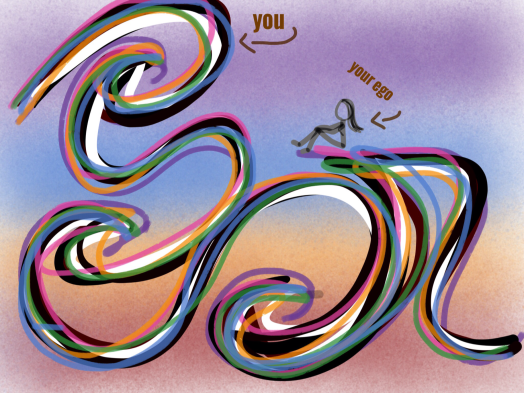
2016-09-16 22.22.08

Back to Colonialism
Colonialism is a systemic force inseparable from our modern desires for property, security, control, choice, comfort, affluence, autonomy, and/or progress. It furtively manifests itself even when we are critical of it and when we say we are working against it. Colonization is a theft of layers, an impairment of being where entanglement cannot be sensed or recognized. Within these fences, care and responsibility are dependent on convictions. In practice, these convictions become moral-utilitarian personal choices that are mobilized to affirm colonial relationships and subjectivities, disguised as moral and benevolent behaviour. Colonization strips care and responsibility away from the visceral command that operates before will, a visceral command that is not a rational choice.

Colonization is a theft of layers, an impairment of being where entanglement cannot be sensed or recognized.

There are at least three inter-related dimensions of colonialism. The cognitive dimension of colonialism traps our imagination into singularities, especially a single story of progress, development and human evolution. This entrapment generates epistemic violence and “epistemicide” eliminating other possibilities of knowing/being. The political/economic dimension can be represented as a dynamic grid of inter-locked meanings, aspirations and relational and organizational practices sustained by exploitation, expropriation and destitution. The grid hides the harmful costs and destructive force of its architecture by giving us a deceptive sense of freedom, innocence and autonomy, and by promising unlimited possibilities for knowledge and justice, while severely restricting what seems realistic, desirable, tangible and intelligible. The existential dimension of colonialism manifests as a denial of unbound relationships [ii], fencing our sense of self and community within layers of separability (“me” and, at best, “me and you”). This denial is rationalized through notions of civilization, superiority and/or exceptionality. It generates indifference, de-humanization, and ultimately, can justify genocide.

Tackling all three dimensions of colonialism together results in forms of resistance that are unintelligible within the grid. Similarly, attempting to undo it exclusively through the first two layers of separability results in paradoxical forms of resistance. This is because colonialism: (a) is rationalized as normal, just, and benevolent; (b) is clever, flexible, and adaptive, (c) is insidious, endemic, seductive, and “delicious” (when we are benefitting from it while foreclosing its costs); and (d) it co-opts resistance by over-coding our senses, our ideas of self, our desires, our perceived entitlements, our treasured securities, our possibilities for relationships, going far beyond just defining our “thinking”. Therefore, deeper analyses and shifts of convictions can help in our understanding of it, but ultimately, we cannot simply rationalize our way out of colonialism: when we declare we have achieved “decolonization,” we are often doing that from a standpoint enabled and sustained by colonialism itself. Our disenchantment with colonialism does not translate into disillusionment with or disinvestment in it. This is partly because, in the first two layers, we don’t know how to exist outside of it, and we are afraid of being “paralysed” by the process, afraid of the loss of epistemic and agentic privilege that colonialism provides, afraid of the loss of our sense of bounded individuality and community, afraid of life beyond the fences.

Within the existential fences of colonialism we tend to believe we are autonomous individuals that relate to the world through our thinking and knowledge alone. Language and knowledge cast a net of categorical boxes that capture and rank entities in the world around us, according to the grid. These boxes deprive us from experiencing relationships not mediated by meaning. We get sick within the fences of separability and bored with the categorical boxes, but we can only imagine and desire change within the grid itself: we want different content in the boxes without changing their frames, we want change that is recognizable, affirming and familiar; like saying you want change, but thinking only about a change of clothes: something lighter or warmer, trendier or easier to wash. Only those who have torn their clothes themselves are ready to strip down naked.

Decolonization
Changing frames and fences can be very uncomfortable, since it demands cleaning up, stepping up and growing up. This involves being present (to the collective pain), remaining in resonance (with the call for responsibility), practicing release (of attachments to boxes, false promises and perceived entitlements), and keeping ourselves in balance (with truck loads of patience, humility, compassion, generosity and radical tenderness [iii]). Who would choose to do this? Or . . . can we afford to continue not to?

Jacqui Alexander [iv] refers to the colonial enforcement of separability as a process of dismemberment. This dismemberment happens both at physical and psychic levels. She says that we all feel a yearning for wholeness (which we can find in the third layer), but that we confuse this (in the second layer) with a yearning to ‘belong’. The focus on belonging then makes us build more fences and make more boxes: of citizenship, of political/cultural/sexual orientation, of struggle, of relationships bound by expectations of convictions and identities in the struggle for power and promised entitlements (for voice, identity, recognition, representation, redistribution). This reproduces the very dismemberment that caused the yearning in the first place. New fences and boxes can give us some temporary respite from perceived (and real) threats, but they unavoidably reproduce the void and sickness of separation. Jacqui states that the yearning for wholeness can only be addressed through “that space of the erotic, that space of the Soul, that space of the Divine” (p. 282), all spaces of merger and entanglement.

From this perspective, decolonization is the process of interrupting the satisfaction we have with the perceived enjoyments, securities and entitlements afforded by colonialism. It cannot be done by merely replacing convictions, issuing apologies, performing tokenistic gestures expecting redemption, affirmation or gratitude, or presuming reconciliation through alliance, inclusion or integration on colonial terms. Decolonization requires an expansion of layers of reasoning, of sensing, of being, of visceral care and responsibility. It is a process of undoing that is initially messy and agonizing as it demands that we confront our fears: of facing sanctioned denials; of confronting our own violence; of being overwhelmed by our collective pain; of having our personal dreams, rights and self-images annihilated as we lose our individual selves and moral high grounds in realizing we are one another. The practice of this kind of visceral relations and responsibilities grounds a form of agonistic politics that finds little use for declared convictions. However, having provisional, transitional and precarious vocabularies that can gesture towards these possibilities may be useful, and that is what this story has tried to accomplish.

Learning spaces that can support this process…prioritize de-centering over leadership; disarmament over empowerment; discernment over conviction; and disinvestment over revolution.

Counter-Intuitive Learning Spaces
Rediscovering our capacity to imagine beyond boxes, fences, posturing, certainties, and safety blankets, requires different questions and different vocabularies anchored in the uncertainty and precariousness of our entangled collective vulnerabilities. It requires a move from epistemic certainty (where we hold on to the boxes and fences that sustain colonialism, demanding a language that will “show us the way”), to epistemic reflexivity (where we get disenchanted and, ultimately disillusioned with the false promises and pleasures of our frames and fences), and to a (fleeting) state of onto-epistemic openness (where we experiment with other possibilities for being/knowing without grafting them into what we are familiar with). It is in this state that we learn to align all four layers, and start to perceive ourselves not as eitherseparate or entangled, but as both separate and entangled in a non-dialectical way. In order to do that, changing our relationship to language and knowledge, to boxes and fences, is key: we need to recognize multiple layers of sensing, of reasoning, of knowing, what these layers can do, and how they are all partial and limited, insufficient and indispensible, how they open and/or close possibilities for existence.

Learning spaces that can support this process are counter-intuitive within the grid, as they emphasize the importance of complex existential questions instead of the search for (often simplistic) self-affirming solutions. These spaces prioritize de-centering over leadership; disarmament over empowerment; discernment over conviction; consent over consensus; pluriversality over univocality; and disinvestment over revolution. In these spaces participants are called to recognize that decolonization is a life-long and wide trans-generational multi-dimensional process without guarantees, a process that requires us to keep our eyes, pores, flesh and dreams wide open. These spaces require a commitment to depth of reflection and faith in our capacity to relate, to see ourselves in each other, in ways not mediated by agreements, identities, knowledge or understanding.  Within these spaces precarious vocabularies that “refuse” to tell us the “only right way” are key.  They can help us to clarify different positions (without ranking them), to trace our thinking back and forth (without (self)censorship), to face our paradoxes and contradictions (without shame), and to develop the stamina to walk together differently, welcoming both uncertainty and indeterminacy, without the option of turning our backs to one another. From the perspective of the first two layers, this will seem impossible to initiate or to achieve.

When I think about the urgencies of decolonization, I often remember that I don’t know how young people in my family will survive the inevitable crash of this destructive casino economy. I don’t know for how long they might have access to technology, employment, health care, freedom of expression, and/or safe water. I don’t know who they will fall in love and have children with. I don’t know who their great-grandchildren will be seven generations from now: whether their bodies will be normative, where they will fit in the social hierarchies that might exist in their time, whether they will conform or rebel. I ask myself: Seven generations from now, what will I have been responsible for? What do I need to do right now to nurture the possibility of a viable world for this family? What kind of politics, relationships, language and forms of existence are necessary to enact this inter-generational responsibility? And what if the “family” is not just the people I have blood ties with? What if, beyond notions of linear time, these great-grandchildren are already around me?


[i] See for example Eve Tuck and K. Wayne Yang “Decolonization is not a metaphor”, available at http://decolonization.org/index.php/des/article/view/18630

[ii] See Dwayne Donald’s “Forts, curriculum, and Indigenous Métissage: Imagining decolonization of Aboriginal-Canadian relations in educational contexts” available at http://mfnerc.org/wp-content/uploads/2012/11/004_Donald.pdf

[iii] Inspired by the “Radical Tenderness Manifesto” available at https://danidemilia.com/radical-tenderness/

[iv] See “Pedagogies of Crossing: Meditations on Feminism, Sexual Politics, Memory, and the Sacred”, Jacqui Alexander, 2005.

This text was first published at http://artseverywhere.ca/2016/10/12/multi-layered-selves/

fences

“My first years here, in this place people call Canada, were really hard. As I was trying to navigate the immigration track for family sponsorship, I had  a recurrent dream where I was thrown against a barbed-wire fence over and over again. The sharp blades slashed my skin exposing my flesh in extremely painful ways. I  tried to show it to the people who benefitted from the fence and they refused to acknowledge it. They felt sorry for the wounds, but would not recognize their investments that kept the fence in place. This hurt more than the exposed flesh. In every dream, I kept insisting on them seeing the flesh, the blood and their “nails” in the fence, but there was no response apart from pity. I became more and more frustrated and wanted to keep the wounds open in the hope that they would eventually see how much the fence was hurting other people. It felt like if I allowed my wounds to scar I would be betraying those who were also hurt by the fence.  The wounds got infected with anger, the chronic pain started to drive my existence, and joy began to be a rare occurrence for me and my family (and when it occurred it made me feel guilty because it felt like deception).
 .
Then something different happened. In one dream, there was a song. And the song entered my flesh and moved me to dance (in a “voguing” way). And as I danced, the density of my body changed and, as I was thrown back to the barbed wire, it could no longer slash my body. I passed through it, back and forth, without being affected. The song moved the wounds to turn into scars and the scars made the singing and the dancing more exuberant. As I learned to sing and to dance in that frequency, those who refused to acknowledge the source of the wounds got interested in what I was doing. As I looked closer, I realized they too were wounded by barbed wires inside their bodies, hidden under their skin. Their organs were wrapped in them. This gave them a sense of containment and security. However, their lifeforce was hurting and desperate, also yearning to sing and to dance.”
 .
vanessa andreotti
 .


2017-02-06 21.14.25 copy