Preface
This draft document is based on conversations that have happened during an on-going year-long collaborative process between Elwood Jimmy and Vanessa Andreotti as part of their work with the Musagetes Arts Foundation. This collaboration involves several modes of relational engagement with Indigenous and non-Indigenous artists, scholars, and communities, including visits, gatherings and consultations, addressing the following questions:
- What are the conditions that make possible ethical and rigorous engagement across communities in historical dissonance that can help us move together towards improved relationships and yet-unimaginable wiser futures, as we face unprecedented global challenges?
- What are the guidelines and practices for ethical and respectful engagement with Indigenous senses and sensibilities (being, knowing, relationships, trauma, place, space and time) that can help us to work together in holding space for the possibility of “braiding” work?
- How do we learn together to enliven these guidelines with (self-)compassion, generosity, humility, flexibility and rigour, and without turning our back to (or burning out with) the complexities, paradoxes, difficulties and pain of this process of healing?
- What kind of socially engaged and community anchored Indigenous-led arts-based program can support this process in the long term?
- What are the expectations in terms of responsibilities of the organization to the place/land and her traditional ancestral custodians from the perspective of the local Indigenous communities?
We honour those who have inspired the insights in this document so far, and thank them again for their time and generosity in sharing their stories and wisdom with us. We would also like to thank everyone at the Musagetes Foundation for making it possible for this process to happen. Personal acknowledgements will be made in the final version of this document that should be completed by January 2019.
We are grateful for any feedback, comments and suggestions.
Elwood and Vanessa
Preamble
Ahenakew (2016) states “the denial and denigration of non-Western ways of knowing has been part and parcel of European colonialism and a primary means by which the universality of Western knowledge has been asserted and used to justify dispossession, destitution, and genocide of populations who were perceived to be lacking knowledge of universal worth (but who occupied lands of strategic importance)” (p. 327). Maldonado-Torres (2004, 2007) along with other scholars in Latin America (Escobar, 2004; 2007; Mignolo, 2007a; 2007b; 2012; Quijano, 1999; Walsh 2012) uses the term coloniality to refer to the enduring consequences of this configuration of power. He (Maldonado-Torres, 2007) argues that coloniality defines “culture, labor, intersubjective relations, and knowledge production well beyond the strict limits of colonial administrations […] it is maintained alive in books, in the criteria for academic performance, in cultural patterns, in common sense, in the self-image of peoples, in aspirations of self, and so many other aspects of our modern experience.” (p. 243). Sousa Santos (2007) affirms that modern experience is constructed around “abyssal thinking” whereby what is not legible as real and desirable within a modern grammar of experience grounded on seamless progress, linear time and Cartesian rationality, is perceived to be worthless or inexistent.
Against this background, efforts towards decolonization, Indigenization and inclusion and solidarity towards historically marginalized groups need to be problematized. Scholars who have critically examined the limits and paradoxes of inclusion and solidarity have shown how unexamined seemingly benevolent practices tend to reproduce the same affective and performative investment patterns that characterize colonial relations (see Andreotti, 2011; Ahenakew, 2016; Ahmed, 2012; Gaztambide-Fernández, 2012; Hoofd, 2012; Kerr & Andreotti, 2018; Thobani, 2007; Shotwell, 2017; Suša, 2016;). Ahmed (2012) draws attention to how the will to include diversity becomes a wall to diversity becoming normalized in modern (academic) institutions. Through her empirical research, she shows how diverse bodies are instrumentalized towards institutional agendas, through a politics of stranger making: “how some and not others become strangers, how emotions of fear and hatred stick to certain bodies, how certain bodies become understood as the rightful occupants of certain spaces” (p. 2). Within this logic, if an organization perceives diversity as desirable, it will also define what is desirable about diversity and select diverse bodies and dispositions that will perform accordingly. This means that aspects, bodies and dispositions perceived as undesirable may not be tolerated. By creating a contained and controlled space for diversity to be expressed, organizations re-assert their territoriality. Thus, ‘strangers’ are made to feel like they should perform to expectations, avoid conflict and feel grateful for being allowed to exist in ‘other people’s’ spaces. Their success depends on whether or not they perform the authorized and expected content of diversity they were brought in to express. They are also expected to make those who have opened and enabled the space for diversity feel good about themselves (Ahmed, 2012). These insights are echoed in the works of Indigenous scholars in the discipline of education who problematize decolonization and Indigenization, such as Battiste (2002), Marker (2004), Tuck and Yang (2012), and Ahenakew (2016).
Through the engagement with social cartographies depicting these trends, Indigenous participants in the gatherings so far confirmed that it is extremely common to see liberal organizations in Canada reproducing what Ahmed describes and that it is very difficult to articulate these patterns and their effects on Indigenous wellbeing in the field. Common examples shared included organizations expecting that the inclusion of Indigenous people would placate criticisms of colonialism, that Indigenous staff (artists and/or curators) would be able to represent the relationship of the organization with all Indigenous communities, that Indigenous staff and their communities would be willing to “move forward” on the organization’s terms, that Indigenous staff and communities would be grateful for the opportunity to perform non-threatening aspects of their culture when the organization deemed appropriate, that Indigenous staff and communities should have a commitment to harmonious relationships, and that Indigenous staff should perform loyalty to the organization by not challenging the terms of inclusion.
The conversations that have happened during the gatherings organized so far indicate that the wall of inclusion described by Ahmed is a stark reality for Indigenous artists in Canada and that this wall prevents conversations like this from taking place. Many feel that efforts to represent Indigenous cultures are more often than not tokenistic as they instrumentalize Indigenous bodies for immediate cultural consumption rather than the healing and braiding of relationships or the needs of Indigenous communities in the long term. Some Indigenous artists engage in these processes for personal income generation, profile building or just as a matter of survival, some engage strategically in order to be able to work in often unfunded or un-fundable parallel projects in their own communities, some engage to push forward Indigenous agendas of redress, others refuse to engage. A common perception was that, for organizations, it is much easier to engage with an Indigenous person who has been educated into middle-class language, dispositions, aspirations and sensibilities, rather than an Indigenous person coming from direct experiences of both collective trauma and resilience and who dis-identifies with middle-class sensibilities and aspirations for social mobility.
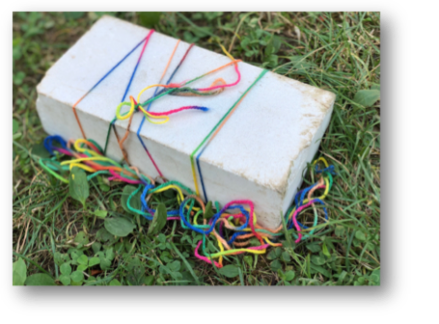
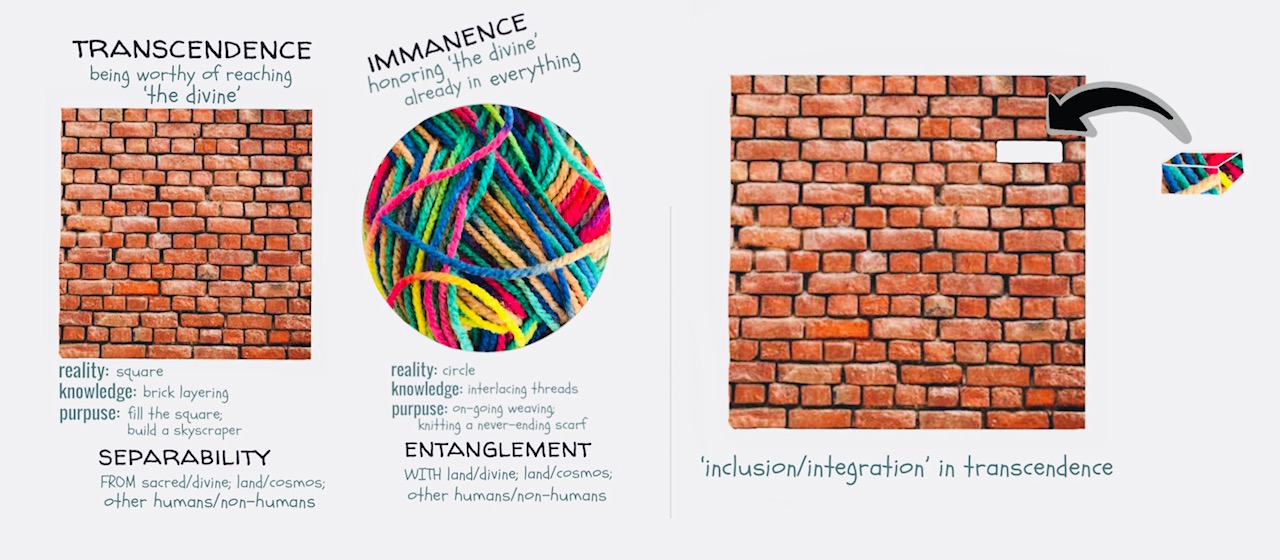
However, social cartographies developed in the project so far also indicate that the complexities of settler-colonial relations cannot be captured by a simple distinction between Indigenous and non-Indigenous ways of knowing and being, since both Indigenous and settler contexts are highly heterogenous. We have tested different framings of the distinct sensibilities involved in this historical and political context and have found that a distinction between transcendence and immanence offered a better tool for analyses of tensions and possibilities for new forms of engagement. A cartography using the metaphor of construction bricks (transcendence) and knitting threads (immanence) proved very useful in engaging Indigenous artists in conversations about the tensions of working in non-Indigenous institutions and the essential steps that could enable possibilities for new forms of collaboration.
Recent social cartographies point to a problematic endemic pattern in organizations seeking tokenistic and self-promoting forms of inclusion that are deeply frustrating for Indigenous artists in general, but particularly to those whose work is grounded on immanence (threads). Three principles were identified as enabling ways forward: 1) creating spaces for the integrity of immanent orientations to be restored and/or protected alongside spaces of generative transcendence; 2)recognizing inevitable complicities in the reproduction of historical and systemic harm and committing to harm reduction; and 3) developing stamina and resilience for the long haul of the difficult work of interrupting onto-epistemic violences and working collaboratively towards new possibilities for co-existence.
This text presents the “Bricks and Threads” social cartography and presents the identified principles in more detail.
BRICKS AND THREADS:
Analogies for different sets of ways of knowing/being
Brick sense and sensibilities emerge from an onto-metaphysical foundation (transcendence) that sees the divine as separate from humans, that sees this divine as sublime and complete, and that sees the purpose of humans as becoming worthy of reaching the divine or becoming divine (this can manifest in both religious or secular ways).
In this analogy, BRICKS stand for a set of ways of being
- that emphasize individuality, fixed form and linear time;
- where the world is experienced through concepts that describe the form of things and places them systematically in ordered hierarchical structures;
- where the value of something is measured against its capacity, achievement or potentiality to “move things forward”;
- and where self-worth is dependent on external validation.
Thread sense and sensibilities emerge from an onto-metaphysical foundation (immanence) that sees the divine as manifest within everything and beyond, that sees this divine not as static and all-knowing, but as ever-changing and learning, and that sees the need for humans to notice and honour its manifestations and unfolding lessons without arrogance.
In this analogy, THREADS stand for a set of ways of being
- that emphasize inter-wovenness, shape-shifting flexibility and layered time;
- where the world is experienced through sensorial events involving movement, rhythm, sound and metaphor;
- where every “thing” (including humans, non-humans and the land) is a living entity;
- where every entity is valued for its intrinsic (insufficient and indispensable) medicine within an integrative and dynamic whole;
- and where their self-worth is grounded on their connection with something beyond the individual self, but found within it.
Implications
ONTOLOGY/ WAY of BEING
Brick sensibilities are goal and progress oriented. They demand that we share the same convictions about reality in order to engineer proper political, ideological and institutional structures that will in turn engender adequate social relations (i.e. adequate conditions will build adequate institutions that will secure adequate relationships). The focus on “engineering” is knowledge-based, methodological and based on consensual decision making. Human purpose can be imagined as building monuments and walls that will last and leave a traceable legacy that attests to the worth and virtue of the individuals involved in contributing towards the imagined idea of progress. Conversely, thread sensibilities are oriented towards relationality. They require that we sense entanglement in order to weave genuine relationships, which will in turn command responsibility for collective wellbeing as a grounding force for adequate (new) political and institutional systems (i.e. adequate relationships will build adequate capacities to work together that will secure adequate processes). The focus on collective wellbeing invites the surrender of individual entitlements for a greater good, and calls for a level of ongoing stretch-discomfort within a container of unconditional relationality. Human purpose is associated with “walking in beauty and wisdom”, offering one’s medicine to enable the continuity of life and related to a preoccupation of having minimal impact on others (respecting their primordial freedom), and “leaving no footprints”.
EPISTEMOLOGIES/ WAYS of KNOWING
Brick sensibilities take language to be something that describes and indexes the world. Knowledge is something that can be discovered and/or transmitted, and accumulated. This accumulation is documented in writing, therefore knowledge can be mostly found in books. Knowledge is measured according to its capacity for accuracy in describing, predicting or building effectively, and is something people feel entitled to, although they may need to pay for it. Thread sensibilities take language to be both practical and metaphorical. Language can never describe the unknowable wholeness of the world, but it is extremely useful to move things in the world. In this sense, both language and knowledge are ‘entities’ whose impact is evaluated not by their accuracy in describing something, but in their contribution to the metabolic wellbeing of the whole. In this case, knowledge can come from many places (the land, altered states of conscience, non-humans) and is something that is earned (not an entitlement).
COMMUNICATION
Brick sensibilities tend to communicate through “thick scripts” of normativity, protagonism, reason and virtue that take different forms in different contexts. Thread sensibilities tend to communicate through modes of self-effacement, relationship-weaving, intro/inter-spection and metaphor that are “thin-scripted” as they are grounded in the unknown and unknowable.
In modern institutions/relationships, thread communication and sensibilities tend to be muted/rendered unintelligible, therefore those who want to “be heard” from the thread space need to learn to translate their message into the mode of communication that is legible to the dominant brick sensibility. This is not only deeply frustrating, but also often ineffective, pushing the orientation towards a non-generative manifestation. Thread practices are also often selectively adopted/instrumentalized by brick orientations as a means to improve effectiveness, to enact “inclusion” or as a branding “currency”.
Important caveats
- There is a variety of brick sensibilities and variety of thread sensibilities, but each are grounded in transcendence or immanence, respectively.
- The sensibilities of both bricks and threads can manifest in generative and non-generative ways.
- The universalization of bricks or threads is highly problematic as it makes invisible the limitations of the sensibility that seeks universalization and attempts to delegitimize and/or erase the other sensibility.
- Social groups that depend on a deep relationship with the land as a living entity tend to lean towards the thread sensibility. Social groups that see the land as an object, resource or property lean towards the brick sensibility.
- Indigenous groups are known to work with and through threads, while colonialism is known to violently impose bricks.
- While it is important to highlight that settler-Indigenous relations are grounded on the harm that bricks have inflicted on threads, it is also important to complicate this relationship by acknowledging that many Indigenous groups and individuals have adopted brick-related ways of being and a few settlers have developed senses and sensibilities that enable them “to thread” (and some are penalized for that).
- Despite threads being used in political and academic discourse to characterize the struggle of indigenous peoples, it is problematic to directly or universally equate indigeneity with threads, partly because of historical circumstances that have privileged the power and allure of the bricks.
- For those over-socialized in contexts where the brick sensibility is the universalized norm and perceived to be rational, neutral, universally desirable, and objective, it is very difficult to grasp that other people (coming from a thread sensibility) could feel the world very differently (these bricks would say that threading is wrong, disingenuous, irrational, insane, deceitful or impossible).
- The integrity of the thread sensibility is often compromise by the institutional demands and perceived entitlements of bricks that are normalized and naturalized as “common sense”.
- Brick sensibilities tend to intrumentalize thread methodologies (ways of doing) for their purpose, when convenient, often without the ability to recognize or to honour the ways of knowing and being where these methodologies came from.
- When bricks engage in processes of inclusion, they generally require threads to be turned into bricks, so that they can become intelligible in the brick wall.
- Acts of transgression that challenge brick normativities are not necessarily a manifestation of the thread sensibilities: bricks often manifest as a competition of normativities (that frequently see threads as another competing non-normative normativity).

Braiding
…a practice-to-come located in a space in-between and at the edges of bricks (transcendence) and threads (immanence) that aims to calibrate each sensibility towards a generative orientation and inter-weave their strands to create something new and contextually relevant, while not erasing differences, historical and systemic violences, uncertainty, conflict, paradoxes and contradictions. We propose three “steps towards braiding” that need to happen before any braiding is possible. They are described in the next section.
BEFORE BRAIDING CAN HAPPEN
Although bricks and threads appear to be incommensurable, it is at the edge-interface of each of these orientations in their generative manifestation that the potential for new imaginings and adjacent possibilities in braiding emerges. However, before braiding can even start to happen, three steps are necessary:
- a deep understanding of historical and systemic harms and their snowball effects needs to become “common sense”, and not something to be avoided out of a fear of hopelessness, guilt or shame;
- a language that makes visible the generative and non-generative manifestations of bricks and threads needs to be developed;
- a set of principled commitments towards the “long-haul” of this process needs to be in place.
In the collaborative process with Indigenous and non-Indigenous participants that ground the development of this document, we shared the brick and threads metaphor and asked participants to identify what could support of hinder practices of braiding. These conversations inform the “steps towards braiding” presented below.
Step 1:
FACING and DIGESTING the implications of HISTORICAL and SYSTEMIC HARM
The political, material, institutional and cognitive impositions and attempts to universilize the sensibility and weight of bricks and to eliminate and/or instrumentalize the threads is on-going and has lasting effects. Indigenous participants identified that it is extremely common to see liberal organizations creating spaces for Indigenous inclusion that foreground transcendence as a default disposition towards shared futures that is normalized and perceived as natural. These includes, for example, organizations expecting that the inclusion of Indigenous people will placate criticisms of colonialism, that Indigenous staff/artists will be able to represent the relationship of the organization with all Indigenous communities, that Indigenous staff/artists and their communities will be willing to “move forward” towards the idealized future anticipated by the organization, that Indigenous staff/artists and communities will be grateful for the opportunity to perform non-threatening aspects of their culture when the organization deems appropriate, that Indigenous staff/artists and communities should have a commitment to harmonious relationships, and that Indigenous staff/artists should perform loyalty to the organization by not challenging the terms of inclusion. Participants also identified that the current political and intellectual climate makes it possible for these criticisms to be articulated at this specific historical moment, something that might not have been possible 10 years ago. This might explain the increase in awareness of conflictual settler-indigenous relationships in recent years, and the pressures to “indigenize” or “decolonize” organizations.
Sarah Ahmed explains these tendencies in her acclaimed book “On Being Included: Racism and Diversity in Institutional Life”. She argues that the will to ‘include’ diversity/Indigeneity in institutions becomes a “wall” to diversity/Indigeneity and that this wall prevents diversity/Indigeneity from becoming habitual. She illustrates how, by making diversity/Indigeneity visible, transcendence is naturalized and diverse/Indigenous bodies are instrumentalized within a transcendence framework for the benefit of organizations. She refers to this as a politics of ‘stranger making’: “how some and not others become strangers, how emotions of fear and hatred stick to certain bodies, how certain bodies become understood as the rightful occupants of certain spaces” (while others do not) (p. 2). Transcendence is naturalized as normal, natural and desirable in ways that make its very power invisible because the power itself is also presented as normal, natural and desirable. Within this logic, if an organization perceives Indigeneity as desirable, it will also define what is desirable about Indigeneity and select Indigenous bodies and dispositions that will perform accordingly. This means that aspects, bodies and dispositions perceived as undesirable may not be tolerated. By creating a contained and controlled space for Indigeneity to be expressed, organizations re-assert their territoriality and normativity. Thus, Indigenous and other ‘strangers’ are made to feel like they should perform to expectations, avoid conflict and feel grateful for being allowed to exist in ‘other people’s’ spaces. Their success depends on whether or not they perform the authorized and expected content of Indigeneity/diversity they were brought in to express. They are also expected to make those who have opened and enabled the space for diversity feel good about themselves.
The conversations that have happened during the events organized so far indicate that the wall of inclusion described by Ahmed is a stark reality for Indigenous and racialized artists in Canada. Many feel that efforts to represent Indigenous cultures are often tokenistic as they instrumentalize Indigenous bodies for immediate cultural consumption rather than the healing and braiding of relationships or the needs of Indigenous communities in the long term. Indigenous participants also expressed that they feel that thread sensibilities are largely unintelligible in organizations framed by the universalization of transcendence/bricks and that, when translating thread sensibilities they need to focus on what is palatable for consumption and considered “productive” and “valuable” according to an organization’s criteria. This leads to different kinds of responses. Some Indigenous artists engage in these processes for personal income generation, profile building or just as a matter of survival, some engage strategically in order to be able to work in often unfunded or un-fundable parallel projects in their own communities, some engage to challenge the terms of engagement and to push forward Indigenous agendas of redress, others refuse to engage. Participants mentioned that there are also those who capitalize on the demand for Indigenous bodies without investments perceived as legitimate by Indigenous communities, for example someone who decides to identify as Indigenous in order to get a job or who wants to claim Indigenous positionality having one’s Indigenous knowledge only learned from books. For organizations it is much easier to engage with an Indigenous person who has been educated into middle-class language, manners, social mobility/consumer aspirations and aesthetic sensibilities, rather than an Indigenous person immersed in practices of immanence/threads coming from direct experiences of both collective trauma and resilience, and who dis-identifies with middle-class affluence aspirations and sensibilities.
Challenges to these usual terms of inclusion tend to tip the transcendence/brick orientation towards its degenerative manifestation. When this happens, organizations blame Indigenous collaborators for failures of expected performance, often attributing personal (moral or professional) deficit to the person in question and expressing a wish to employ more “competent” staff (who will perform to expectations). On the other hand, the transcendence degenerative manifestation also tips the immanence/thread orientation towards its degenerative side, where addressing the un-silencing of pain and colonial violence becomes a priority: for example, when Indigenous people publicly call out neo/colonial organizational practices. When both orientations are caught in a feedback loop of degenerative manifestations, relationships fall apart and people can get seriously hurt in the process. More often than not, Indigenous people leave, organizational structures remain the same and the process starts again with more amenable Indigenous bodies, who, in time, may also feel frustrated and demeaned by this arrangement. The reputation of the organization within Indigenous and racialized communities committed to immanence/threads would be adversely affected in this case, but the economic context is such that there would not be a shortage of differently positioned Indigenous people willing to accept this deal. Not learning from this repeated pattern of failure has extremely high tangible and intangible costs, including Indigenous people burning out and becoming sceptical of organizational intentions, organizations becoming more resentful and less risk taking with Indigenous artists and communities, a massive waste of time, energy and resources, and possibilities for healing and braiding becoming unachievable.
Step 2:
Recognizing GENERATIVE and NON-GENERATIVE MANIFESTATIONS of BRICKS and THREADS
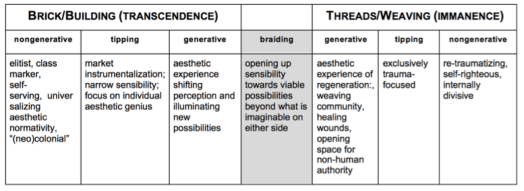
A second step towards braiding is the development of a language that makes visible the generative and non-generative manifestations of bricks and threads as well as the tipping points where generative starts to turn into non-generative. The social cartographies below illustrate how bricks and threads relate differently to: A) settler-colonial relations; B) socially engaged art, C) philanthropy focused on social transformation; D) organizational decision- making; E) employment relationships; and F) time and Western science. The cartographies also propose (in the middle column) the possibilities for braiding that would be open when brick and threads are brought together in their generative manifestations.
Settler-colonial relations

Socially engaged art
Philanthropy focused on social transformation

Decision making

Time and Western science*

Step 3:
Investing in PRINCIPLED ACTION COMMITMENTS for the long-haul
The third step towards braiding involves three general principles and related action commitments that need to become “body memory” (embodied and unconscious) before the very possibility of braiding becomes viable (this is not a “knowing”, “understanding” or “thinking” task, but a task of intellectual, embodied and affective engagement):
INTEGRITY: recognizing differences (first priority) and potential complementarities (second priority) between the orientations of transcendence and immanence, including different conceptualizations of self, time, relationships, work ethic, priorities and responsibilities and their practical implications, for example understanding how the practice of being together requires not only an awareness of the limits of knowledge and knowing, but also different sensibilities towards time, expression, collaboration, productivity, ethics and aesthetics that cannot always be articulated.
ACTION COMMITMENT: according equivalence to the importance and value of both immanence and transcendence through priority setting, funding and curation, creating spaces for “in-breath” (deep exploration in each orientation), as well as “out breath” (interfacing work), while acknowledging historical imbalances and harm: not seeing this as an act of concession towards immanence, but seeing it as an act of historical, systemic and existential accountability.
HARM REDUCTION: recognizing and acting upon the impact of systemic violence in all forms, of different scales of trauma, of pain, of burden (e.g. of translation), of responsibilities to place, to non-human relations (e.g. earth, sky and water), to communities, and to ancestors past and yet to come;
ACTION COMMITMENT: investing time, energy and resources in systemic harm interruption in all activities; developing practices of high sensitivity towards tipping points that can sustain generative relations in order to prevent the harm caused by nongenerative incidents (e.g. developing a highly sensitive radar for unarticulated dissent, for homogenizations, for deficit theorizations, and for seemingly benevolent practices that unintentionally replicate oppressive relations).
RESILIENCE: developing stamina, flexibility, and capacity to sustain relationships and collaborations through the difficulties, challenges, complexities and paradoxes of the long haul of working through the legacies of deeply entrenched and endemic historical and systemic harm affecting (unevenly) both sides.
ACTION COMMITMENT: developing practices that can nurture an organizational culture that rewards risk taking and courage to publicly learn from failure; investing both structured and un-structured time learning and building relationships in spaces of immanent practices; taking systemic responsibility for visibilizing violences; situating claims (de-universalizing) and not over-stating achievements; “having each other’s backs” rather than “backing each other up”; acknowledging indebtedness to the earth and the communities upon whose backs modernity was built in order to create a container that encourages and sustains on-going humility and generosity.
For organisations starting this journey…
If you find yourself in a position to “include” Indigenous peoples and perspectives in your organization, then there are many practical, ethical, and educational dimensions and implications to consider before and while doing so. In particular, it is important to consider how your invitation might end up reproducing harmful patterns of relationship and representation, even if your intention is to do just the opposite.
The following questions may help you think through your expectations, your intentions, and the impact of your choices, and to think systemically how these are rooted in a larger social and historical context. We offer both general guiding questions for reflection and discussion, as well as point to some “red flags” that commonly emerge in the context of these engagements and which warrant pause and further consideration before pursuing efforts to include Indigenous peoples and perspectives.
[integrity] What do you expect the Indigenous perspective to do for you?
Think about why are you compelled to seek an Indigenous perspective in the first place, and what assumptions and investments your expectations are rooted in. These expectations will significantly shape what you are able to hear, and not hear, and the sense you make of what you do hear. They might even shape who you invite to present their perspectives, and how you create space for their presence.
Do you want to deepen your understanding of colonialism, learn about/from/with other knowledge systems, or acknowledge or right past wrongs? Or perhaps you are motivated by some of the “red flag” reasons for engagement: making a benevolent gesture seeking redemption, forgiveness, or gratitude from the Indigenous person; generating an alibi to draw upon when your organization comes under critique for colonial actions; affirming your innocence, virtue, social or material capital, or credibility as a ‘good ally’; enhancing your CV and becoming more employable; securing funding or employment stability. These reasons for engagement are likely to recreate rather than interrupt colonial patterns of relationship. What you want, hope, and expect from the experience may be imposing projections on the person(s) you chose to invite, and may also be limiting other, generative possibilities for engagement by keeping you from inviting other perspectives.
Once you have thought about the expectations that are driving and shaping your invitation, then you might consider how you would respond if you were exposed to Indigenous perspectives that do not meet your expectations and projections. What is lost in selectively engaging Indigenous perspectives that will not challenge your expectations? What might be gained from loosening your expectations and opening up to other possibilities? What are the risks to the invited Indigenous people involved in both of these scenarios? What strategies do you have for noticing and interrupting your projections when they emerge? How can you try to ensure that this strategy does not create additional burdens for Indigenous people?
[commitment] What kind of learning are you willing to do?
If engagements with Indigenous peoples are not going to reproduce inherited patterns of relationship or be organized around an instrumentalization of Indigenous perspectives toward your own preconceived ends, then it will require a different approach to learning than many non-Indigenous people are used to engaging. Before you invite anyone to speak, you might therefore ask: How much effort are you, and others in your organization, willing to put into your own learning (and unlearning)?
Indigenous communities and peoples are diverse. Institutions usually privilege perspectives that align safely with the objectives of their stakeholders (e.g. Indigenous people/communities invested in social mobility and economic growth rather than those fighting against pipelines). Institutions also tend to hire Indigenous people who embody familiarity in terms of middle-class language, logic, and sensibility and in terms of normative bodies (e.g. white skin, thin, able and heterosexual bodies). Knowing this, you might ask yourself: Do you want only an Indigenous perspective that is understandable from your point of view? How much will the perspective need to be translated into your sensibility for you to feel satisfied? How equipped are you to have difficult conversations without relationships falling apart? How do you usually respond to having your assumptions challenged? How do you usually respond to being called out on harmful practices that are perceived as normal? How will you respond to Indigenous perspectives that may make you feel uncomfortable, guilty, rejected and/or hopeless? Are you able to engage with and hold space for multiple, competing, or even contradictory Indigenous perspectives among Indigenous people? Individual Indigenous people, like all people, are also complex and contradictory; are you able to engage with and hold space for the full, complex humanity of the Indigenous individuals you work with?
Depending on your answers to these questions, it may be that your organization has not yet done the internal preparation work and self-study that would be necessary for the Indigenous engagement to be generative and to create new possibilities for relationship rather than reproducing existing patterns of harm. If this is the case, do not be discouraged, but do recognize that there is important work to be done by the organization and its members before initiating engagements with Indigenous people. That said, having “good” answers to these questions does not guarantee that mistakes will not be made and harms will not be reproduced. Thus, continuous opportunities for self-reflexivity and honest feedback from both internal and external parties should be intentionally built into your organizational plan for engagement. We consider both the necessity and the challenges of creating these opportunities in the next section.
[harm reduction] What are the hidden costs and labour involved in your invitation to engage?
Indigenous people who work in institutions often feel pressures to conform to the expectations of those who enabled the “inclusion.” There is generally an implicit expectation that Indigenous people should feel grateful for being granted a space, and thus, they are considered ungrateful if they: ask for more space; challenge how the space has been constructed; or say something that contradicts or challenges those who invited them. Thus, even when a space is nominally open to different perspectives, some Indigenous people might feel compelled to keep their thoughts and concerns to themselves and go along with the dominant organizational logics. Out of respect for the relationship, or concern for the backlash, other Indigenous people might say what they think those who invited them want or are readily able to hear. Still others might express their thoughts and concerns in ways that are less direct than is generally expected by non-Indigenous people, and they might therefore be misheard or misunderstood. Finally, some will be more direct about their concerns, and this directness will not always be well received.
In what ways are you taking these complexities, power relations, and different modes of communication into consideration when you invite an “Indigenous perspective”? In what ways might you be “listening” to Indigenous people in selective ways that prevent you from really “hearing” what they are saying? What kinds of attachments and assumptions might be blocking you from hearing, how might these be related to/rooted in larger colonial patterns, and what is your plan for addressing these blockages, if any? What kinds of mechanisms or processes does your organization have in place for receiving and addressing critical concerns in ways that take them seriously and address them openly? Do you recognize that it may be only through long-term engagement and relationship building that difficult and uncomfortable, but meaningful and important conversations between Indigenous and non-Indigenous people might become possible? Do you intend to develop such a long-term engagement, or are you more interested in a one-off transactional relationship? Is your intended form of engagement clear for all parties involved? To what extent are you instrumentalizing and/or appropriating Indigeneity for your own gain? To what extent could your gesture of inclusion be considered tokenistic?
While Indigenous peoples are often saddled with the expectations presumed to come along with “being included,” they also have a lot of demand from their own communities. So, ask yourself: Why should they prioritize your learning needs instead? How much would you pay for the time of an expert in your professional area, and are you paying the same for Indigenous expertise? What do you intend to do with the Indigenous knowledge you engaged with? How can you engage ethically with this learning, rather than treating it as an object of consumption? If you think about the Western education system and its knowledge hierarchies, it takes at least 22 years of formal education for someone to complete a PhD and be considered an expert in a subject area. In Indigenous communities, it also takes several decades for someone to master skills and no one is ever an “expert” as everyone is continually learning until they die. It is problematic for non-Indigenous people to take courses or to spend time in Indigenous communities and to present themselves as “experts” in the communities they gained this (little) knowledge from. In the same way, for Indigenous people who claim their Indigenous identity later in life, or who can and choose to pass as non-Indigenous, it is also complicated to claim Indigenous spaces without having the experience of struggle, pain and resilience that disenfranchised Indigenous people embody.
[resilience] Are you committed to addressing the individual and group conflicts and anxieties that will probably arise?
If you are really committed to undertaking the difficult work of remaking and reimagining relationships between Indigenous and non-Indigenous people, then it is important to realize that this is not something that can happen overnight, but rather something which requires sustained effort, and critical generosity toward oneself and others. If you decide that this is a priority for your organization, then consider the following questions: What practices of engagement might enable relationships to be maintained even in moments of conflict? What strengths are present – or still need to be cultivated – in the organization that can enable difficult, relational work to happen and be shared across multiple people? If you hear something that triggers you or makes you upset, what strategies and group dynamics might help ground you so that you can return to a more generative space, and how can you ensure these strategies don’t rely on Indigenous peoples’ emotional labour? What kinds of human and financial resources is your organization willing and able to devote to this work? Are you expecting immediate, clear results, and if so, what are the potential pitfalls of this expectation, and how might you frame this engagement differently? How can you prepare yourself and your organization for the frustrations, anxieties, and mistakes that will inevitably arise in the process of strengthening non-Indigenous and Indigenous engagements?
Back to braiding:
Towards generative manifestations (existential investments)
What would be necessary to bring and sustain both orientations in a generative mode of engagement (that would make braiding viable and desirable)? We sat with this question for some time and developed a set of recommendations that speak to the fact that working towards braiding is about working towards the possibility of a very different way of being together that requires the interruption of the dominant colonial habit of being. This interruption is not an “informational” problem, but a neurobiological one that demands “neurogenesis”. We would like to explore the neurobiological dimension of this work further, in subsequent collaborations. For now, the following recommendations may gesture towards both the joys and the difficulties of a braiding commitment.
The statements in italics represent what people operating from generative immanent orientations, generally coming from historically marginalized communities (and used to being silenced) would say about the space and people involved. We are developing a set of statements representing what people operating from generative transcendence orientations would say in the same context.
Recommendations for both orientations
Acknowledgement that, due to historical and systemic circunstances, we begin the journey in the negative, before “zero” (before the starting point)
“I feel that, in this space, there is a recognition that what is considered “normal” for the majority is built on historical violence and reproduces on-going harm”
A deep recognition of each orientation’s limitations and destructive potential (towards the other, the self, life, the future).
“I feel that there is no arrogance in this space, that I can be vulnerable, and that difficult, deep, honest and potentially painful conversations about the complexities and limitations of different ways of knowing and being can happen without relationships falling apart.”
Recognition of historical and systemic often invisibilized patterns of harm/violence and its intergenerational/snowball effects
“I feel I don’t need to constantly explain the effects of colonization/ racism/ and other forms of oppression because people have done their homework.”
De-universalization, de-romanticization, de-idealization
“I feel we have moved beyond the desire for naive hope in simplistic solutions, for essentialist representations, or the security of “knowing” towards the ability to work with paradoxes, complexities and uncertainties.”
Sense of insufficiency, indispensability, inseparability
“I feel that my body, my ideas, my community are not disposable here, even when we do not conform to expectations. I am grateful for the opportunity to work in this context.”
Openness, generosity, compassion before will (not as intellectual choices)
“Here people do not talk about openness, generosity, compassion, it is simply the way they operate and they never boast about it.”
De-immunization towards collective and individual pain
“People definitely can sit with individual/collective pain without shutting it down, wanting quick fixes, or instrumentalizing it towards their agendas.”
5Rs: Respect, Relevance, Responsibility, Reciprocity, Relationality
“YAY!!!:)”
Recommendations specifically for transcendence
(those over-socialized in the brick sensibility)
“Responsibility towards” replacing “responsibility for”( beyond paternalistic language of inclusion, concessions and compromise)
“Here is one of the few spaces where I don’t feel patronized, tokenized or undervalued. I feel people here moved beyond paternalistic forms of engagement towards a commitment to equanimity and historical accountability”
Recognition of the gift of holism as a first step
“People here understand the limits of rationality and want to activate other senses to engage with the world, which is great. They might not understand what “we” mean by holism, but they sense that there is something beyond knowledge that is very important and that needs space, care and attention.”
Developing an “allergy” and radar towards self-engrandizing/ self-promoting tendencies
“Here I am not asked to be in the “equity” photo for the organization or for someone’s facebook. People are humble and genuinely interested in doing the difficult work without taking credit for it. It is not about what they can tell their friends, their “legacy”, their CVs, their “capital”, or their credibility in their networks.”
Moving beyond the dichotomy of virtue/vice
“People here do not need to feel above or below anybody – there is no need to “look good, feel good and be seen to do good”. They understand we are all human – limited, contradictory and potentially harmful, and that we are doing the best we can from where we are at in our journeys, living through good and bad days. They have a good sense of humour and can laugh at themselves when they are being ridiculous.”
Moving beyond fragility/naïve hope/depoliticization, and the need for validation demanded from othered bodies
“People here have developed emotional maturity. I don’t feel I am asked to please people, to elevate them or to center their needs and experiences because they cannot handle their unprocessed feelings of guilt, shame, inferiority or worthlessness. I feel I can be in my body without being worried about how other people feel about it and that this body is not instrumentalized to meet other people’s needs for validation.”
Humility, generosity, compassion
“People here have let go of arrogance. This is something that is deeply felt without any need to talk about it. Relationships are genuine and can handle the good, the bad and the ugly without losing grace, humor and love”
Commitment to protecting the integrity of difference and dissent (rather than seeking comfort in consensus)
“People here have a radar for unarticulated dissent and will stop or slow down so that differences can be present in the space (even in inarticulable forms) and honoured (even when they make things more difficult). We don’t have to be on the same page, but we are committed to staying in the same wavelength, working together.”
Surrendering what has been most pleasurable and rewarding within modern-colonial structures that have been designed “for you” at others’ expense (e.g. sense of authority, deservedness, superiority, prestige, merit, entitlements, right to arbitrate justice)
“We can genuinely sit together, feel the collective pain, mourn what we have already lost, and also dance, cook, clean up, make jokes and laugh together as we start to heal.”
Recommendations specifically for immanence
(those socialized in the thread sensibility)
Healthy scepticism, replacing mistrust
“There is a long history of suffering in my community and I know that engaging in this process will be seen by many people in my community as betrayal. At the same time, the foundation of mistrust is only producing more suffering. Something has to change and we don’t know how, so we need to experiment in good faith without having our hopes up.”
developing an allergy towards essentializations/ idealizations/ nostalgic romanticizations
“Representing our communities strategically for others or the state has been necessary for our survival in light of what has been done to us, at the same time, these idealized representations have not been able to reflect the complexities or overcome the difficulties we face. These representations have also been instrumentalized in getting us to compete with each other for resources and space. We need different ways to engage with each other and more honest and nuanced conversations about this within and between our communities.”
Moving beyond reversing hierarchical binaries
“The “us-good” versus “them-bad” can be a useful dichotomy in a few circumstances (when everything else fails), but, ultimately, it is ineffective in addressing the complexities and magnitude of the problems we face, trapping us in circular critiques that prevent us from moving somewhere else. Recognizing the spectrum of possibilities for generative and damaging acts in all of us is a starting point for something different.”
Beyond instrumentalizing suffering
“Contemporary modern narratives of social justice create an economy of victimization that rewards the instrumentalization of individual and collective pain as a means of redistribution or individual capital accumulation. Although this may bring some temporary gains (or celebrity status), this is unsustainable and traps our communities in continuous wounding: we become dependent on the pain for our “gain” within the system. Eventually, we start to attack people within our own communities as well. Wounds need to scab, scar and ultimately heal and we need to find a way for that to happen.”
Beyond self-righteousness/ moral high ground as pain-relief
“In a context where being historically and systemically silenced causes chronic pain, it is understandable that “being heard” works like pain-relief. However, this kind of pain management is also unhealthy and unsustainable in the long term as it traps the user in a feedback loop where the search for the “high” of each intervention (dependent on other people’s validation) replaces the process of healing, like an addiction, and divides our communities.”
Patience, compassion, generosity
“For communities that are constantly subject to violences and violations and called upon to make space for and serve dominant communities, asking for patience sounds like a tall and unfair order. At the same time, without patience, compassion and generosity we tend to mirror the violences we are subject to and socialize our unprocessed traumas within our families and communities. We need to find another way.”
Commitment to protecting the integrity of metabolic movement (rather than seeking value/validation/security in dissent/stalling)
“When we are often forced into consensus in order to legitimize and offer hope and comfort to dominant groups/organizations/institutions, stalling processes through dissent can be a powerful strategy of interruption. However, when our sense of self-worth becomes attached to dissent, genuine collaborative movement becomes impossible. The wider metabolism we are part of depends on movement for its survival.”
Surrendering what has been most effective in “pushing back” within modern-colonial structures and that has offered a band-aid to the colonial wounds (including the desire for retribution)
“Both our great-grand-children and their great-grand-children deserve better. What really matters is what matters when we are no longer here, in bodies we inhabit today.”
[to be continued, comments welcome!]
References
Ahenakew, C. (2016). Grafting Indigenous Ways of Knowing Onto Non-Indigenous Ways of Being: The (Underestimated) Challenges of a Decolonial Imagination. International Review of Qualitative Research, 9(3), 323–340.
Ahmed, S. (2012). On being included: Racism and diversity in institutional life. Durham: Duke University Press.
Andreotti, V. (2011). Actionable Postcolonial Theory in Education. New York: Palgrave McMillan.
Andreotti, V., Stein S., Pashby K., & Nicolson M. (2016) Social cartographies as performative devices in research on higher education. Higher Education Research & Development, 35(1), 84–99.
Battiste, M. (2002, October). Indigenous knowledge and pedagogy in First Nations education: A literature review with recommendations. Ottawa: Indian and Northern Affairs Canada.
Gaztambide-Fernández, R. A. (2012). Decolonization and the pedagogy of solidarity. Decolonization: Indigeneity, Education & Society, 1(1), 41–67.
Hoofd, I. M. (2012). Ambiguities of activism: Alter-globalism and the imperatives of speed. New York: Routledge.
Kerr, J., & Andreotti, V. (2017). Crossing borders in initial teacher education: mapping dispositions to diversity and inequity. Race, Ethnicity and Education, 1–19, doi:10.1080/13613324.2017.1395326.
Maldonado-Torres, N. (2004). The Topology of Being and the Geopolitics of Knowledge: Modernity, Empire, Coloniality. City, 8(1), 29–56.
Maldonado-Torres, N. (2007). On the Coloniality of Being: Contributions to the Development of a Concept. Cultural studies, 21(2–3), 240–270.
Marker, M. (2004). Theories and disciplines as sites of struggle: The reproduction of colonial dominance through the controlling of knowledge in the academy. Canadian Journal of Native Education, 28(1–2), 102–110.
Mignolo, W. (2007a). Delinking: The rhetoric of modernity, the logic of coloniality and the grammar of de-cloniality. Cultural Studies, 21(2–3), 449–514.
Mignolo, W. D. (2007b). Introduction: Coloniality of power and de-colonial thinking. Cultural studies, 21(2-3), 155-167.
Mignolo, W. D. (2012). Local histories/global designs: Coloniality, subaltern knowledges, and border thinking. Princeton: Princeton University Press.
Quijano, A. (1999). Colonialidad del poder, cultura y conocimiento en América Latina. Dispositio, 24(51), 137–148.
Shotwell, A. (2016). Against purity: Living ethically in compromised times. Minneapolis: University of Minnesota Press.
da Silva, D. F. (2007). Toward a global idea of race (Borderlines Series Vol. 27). Minneapolis: University of Minnesota Press.
de Sousa Santos, B. (2007). Beyond Abyssal Thinking: From Global Lines to Ecologies of Knowledges. Review (Fernand Braudel Center), XXX(1), 45–89.
de Sousa Santos, B. (2015). Epistemologies of the South: Justice Against Epistemicide. New York: Routledge.
Suša, R. (2016). Social Cartographies of Internationalization of Higher Education in Canada. A Study of Exceptionalist Tendencies and Articulations. University of Oulu: Oulu. Doctoral thesis.
Suša, R., & Andreotti, V. (2018) Social Cartography in Educational Research. Oxford Research Encyclopedia of Education. Revised and submitted.
Thobani, S. (2007). Exalted subjects: Studies in the making of race and nation in Canada. Toronto: University of Toronto Press.
Tuck, E., & Yang, K. W. (2012). Decolonization is not a metaphor. Decolonization: Indigeneity, education & society, 1(1), 1–40.
Walsh, C. (2012). “Other” Knowledges, “Other” Critiques: Reflections on the Politics and Practices of Philosophy and Decoloniality in the” Other” America.” Transmodernity, 1(3), 11–27.





















 Gesturing Towards Decolonial Futures